
Introduction
Have you ever noticed how easily students confuse acute, obtuse, and right angles, even after multiple lessons? The problem isn’t attention, it’s context.
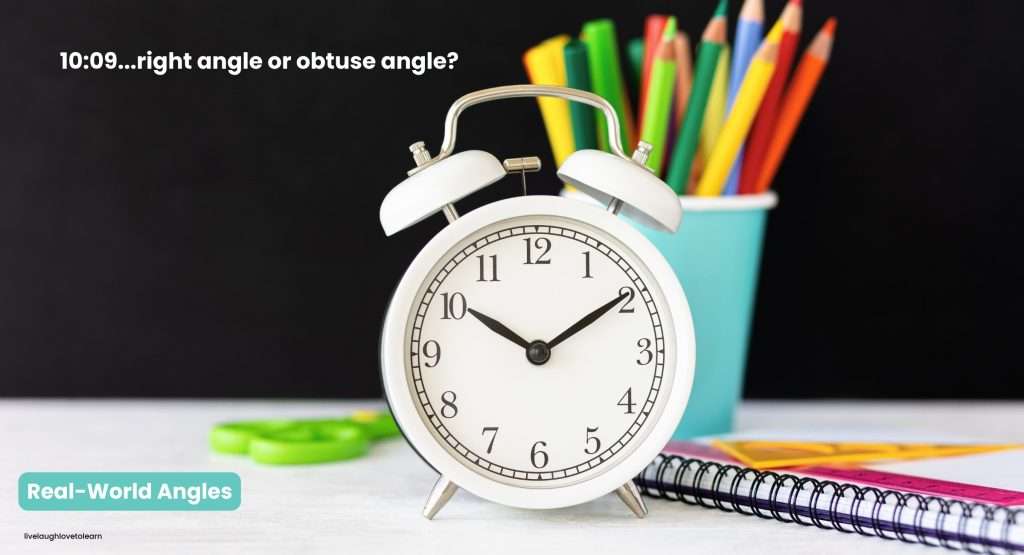
Geometry becomes meaningful when kids see angles not as abstract lines, but as the corners of books, the spokes of a bicycle wheel, or the slant of a ramp.
Teaching angles with real-world examples helps students understand angle types in a meaningful way.
This post will show you practical, hands-on ways to teach the types of angles through discovery, creativity, and real-world exploration. You’ll also find SEL tie-ins, reflection ideas, and free printable resources to make learning stick.
Step 1 – Build Concept Understanding
Start With Simple Definitions
- Acute angles: smaller than 90°
- Right angles: exactly 90°
- Obtuse angles: greater than 90° but less than 180°
- Straight angles: exactly 180°
Use color-coded anchor charts or foldables. Encourage students to gesture with their arms to form each angle, an easy kinesthetic cue.
Vocabulary Talk
Integrate math language into conversation: “What do you notice about this angle?” “How can you prove it’s acute?” This builds communication and confidence, two SEL skills your math block can nurture every day.
Step 2 – Make Angles Tangible With Hands-On Practice
Build Angles With Everyday Materials
Hand out index cards, straws, or craft sticks with brads as pivots. Have students form different types of angles, then measure with protractors.
Challenge them to draw letters or shapes using specific angles (like making an “A” from two acute and one obtuse angle). This turns rote identification into creative exploration.
Create an “Angle Museum”
Set up stations:
- Build It – construct angles with sticks or straws.
- Draw It – sketch and label angles on whiteboards.
- Measure It – use protractors.
- Find It – identify angles in printed photos (architecture, art, sports).
Students rotate and record observations in an Angle Journal.
Teaching angles with real-world examples helps students connect math to everyday life.
💡 SEL Connection: Collaboration and turn-taking during rotations build communication and respect for others’ ideas.

Step 3 – How to Teach Angles with Real-World Examples
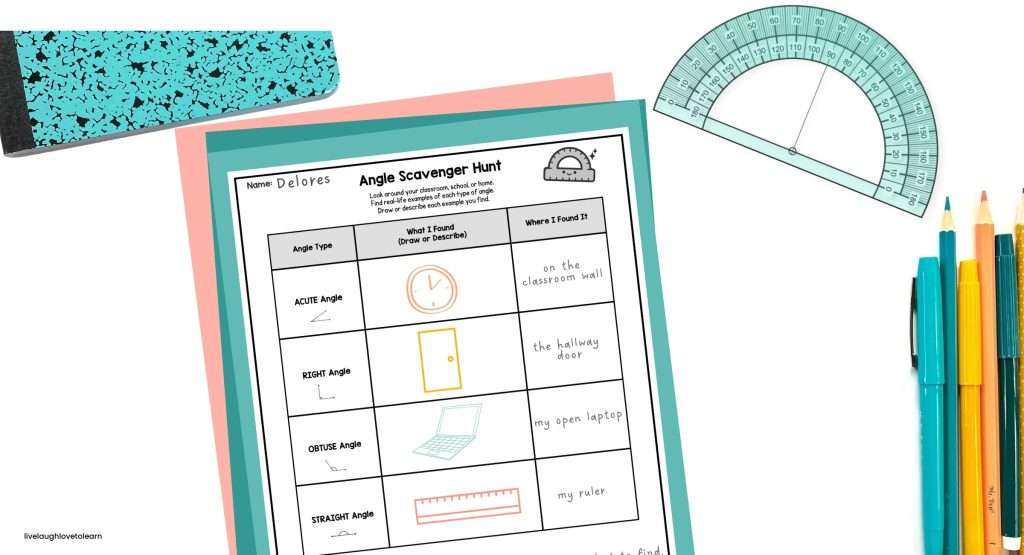
Angle Scavenger Hunt
Take students on a classroom or outdoor Angle Hunt.
- Acute: the top of a triangle in a sign or letter “A.”
- Right: corners of doors, books, windows.
- Obtuse: slanted roofs, chair legs, or ramps.
Provide a recording sheet with columns for “Object,” “Angle Type,” and “Estimated Degrees.”
Real-World Math Discussion
Afterward, gather to discuss:
- Which angle type was easiest to find?
- Which surprised you?
- How do angles affect how things are built or designed?
This simple debrief shifts students from finding to thinking mathematically about design.
Step 4 – Integrate Art, Design, and STEM
Geometric Art Challenge
Students design a symmetrical art piece containing all three angle types. Provide rulers, protractors, and colored pencils. Ask them to label each angle and write one reflection about how it adds to the design’s beauty or balance.
Engineering Extension
Have students design a paper bridge or tower where they must use specified angles for stability. Discuss how different angles distribute weight, this blends geometry with engineering principles.
🧠 STEM Connection: When students adjust their designs after testing, they practice the engineering design process: Ask, Imagine, Plan, Create, Improve.
Step 5 – Reinforce with Games and Digital Tools
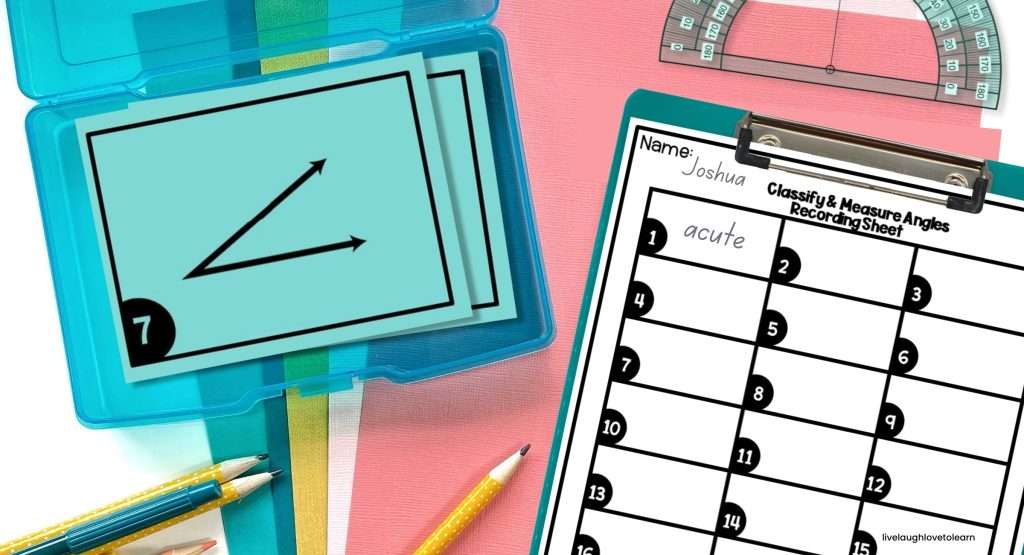
- Angle Sort Cards – Mix cards showing angle types and have partners sort or race.
- Digital Protractor Games – Use interactive simulations (like Toy Theater or Math Playground).
- Classroom “Angle Jeopardy” – Turn review questions into a game show format.
Step 6 – Reflect and Connect to SEL
Journaling Prompts
Ask students:
- What was the hardest part of today’s activity?
- How did teamwork help you solve challenges?
- Which strategy helped you persevere?
Growth Mindset Moment
Celebrate mistakes as part of learning geometry. Share phrases like:
“I’m still figuring out this angle.”
“Every time I measure, I learn something new.”
Connecting SEL reflection with math reinforces both skill sets.
Step 7 – Assessment Ideas
- Quick Check – Call out different types of angles; acute, obtuse, right, and straight. Have students use their arms to create the angle called.
- Photo Portfolio – Have each student upload three photos of real-world angles with labels.
- Exit Ticket – “Explain how a 90° angle is different from an acute angle.”
Step 8 – Differentiate for All Learners
- For support – Use larger visuals, pre-labeled examples, and tactile manipulatives.
- For enrichment – Have advanced learners estimate angles in architectural photos or design a “Math in Architecture” mini-poster.
Step 9 – Wrap It All Together
End the unit with an “Angles Everywhere” Showcase: Students create posters or slides of real-world angles they’ve documented, label them, and share a short explanation of where angles appear in everyday life.
Free Classroom Resource
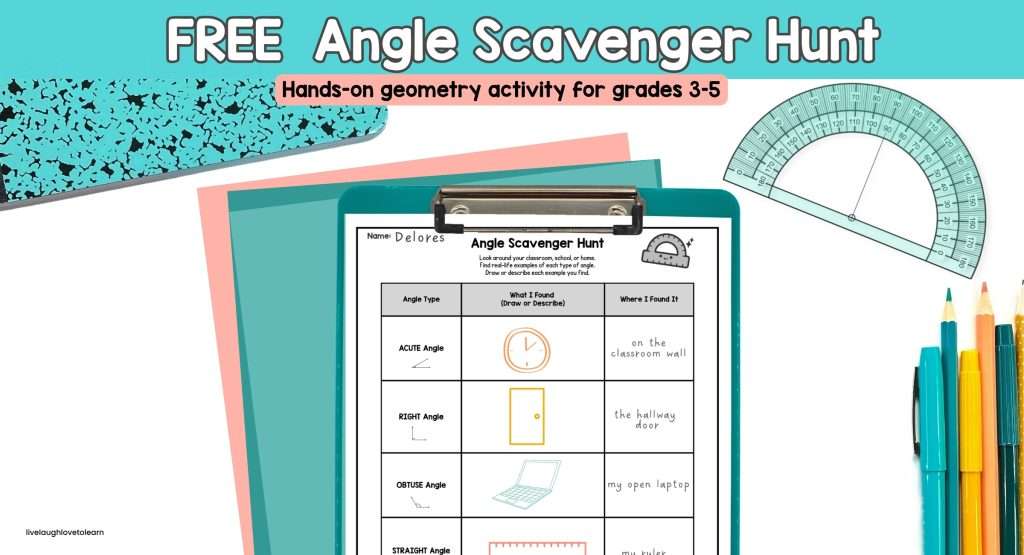
Make angle practice meaningful (and easy!)
Instead of another worksheet, let your students explore angles in the real world.
This simple, low-prep activity helps students identify acute, right, obtuse, and straight angles in a way that actually sticks.
No prep. Just print and go.
✨Related Resources and Next Steps
If you’re looking for more ways to make geometry engaging, here are a few ideas to keep the momentum going:
👉 For even more hands-on strategies, check out this post on 10 Activities to Teach Angles.
👉 Want a real-world connection students love? Grab the Geometry of Football Activity, where students explore angles through sports.
👉 For additional practice, these Angles Task Cards are perfect for centers, review, or small groups.
Conclusion
Angles aren’t just a geometry standard, they’re everywhere students look. By turning abstract measurement into observation, design, and reflection, you’ll help learners see math as part of the world around them.
With a few simple materials and some creative exploration, your next geometry lesson can spark curiosity, collaboration, and confidence, all the angles that matter most.
🌟 Ready to make geometry hands-on? Grab the Angle Photo Scavenger Hunt Freebie and explore more hands-on geometry activities in my TPT Store .
Here’s to helping your students see math in the world around them,
