If you’ve ever sat in a staff meeting and heard “STEM” thrown around without anyone really defining it, you’re not alone.
I thought I knew STEM cold. Seventeen years as a research scientist, then nineteen more in a K–5 classroom. But early on I realized I couldn’t actually answer a pretty basic question: what am I trying to build in these kids? Science facts? Math fluency? A really impressive relationship with masking tape?
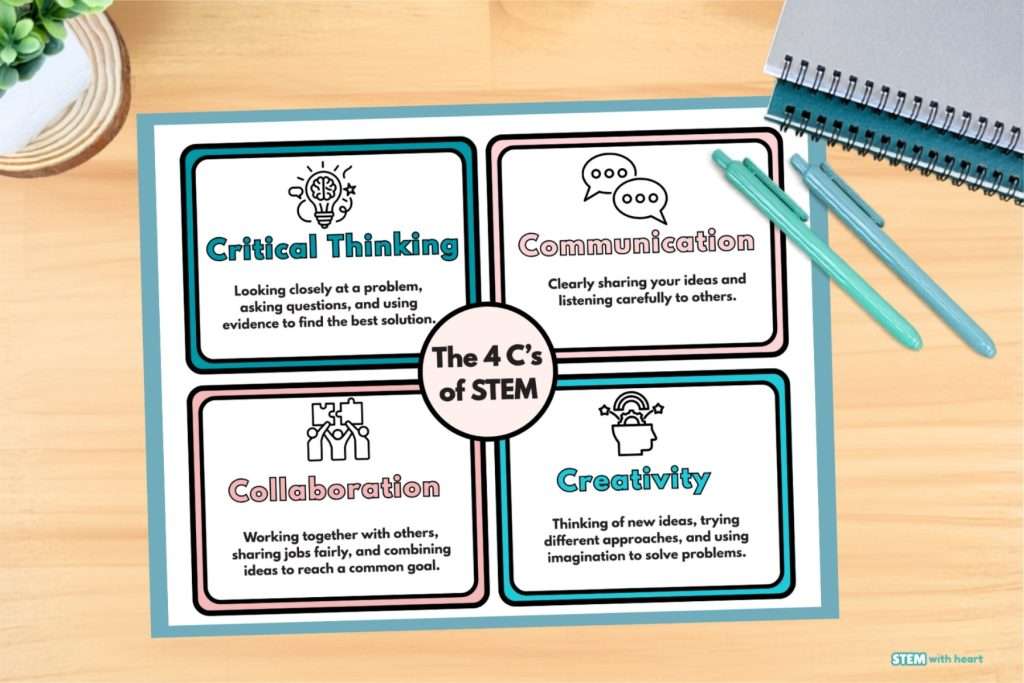
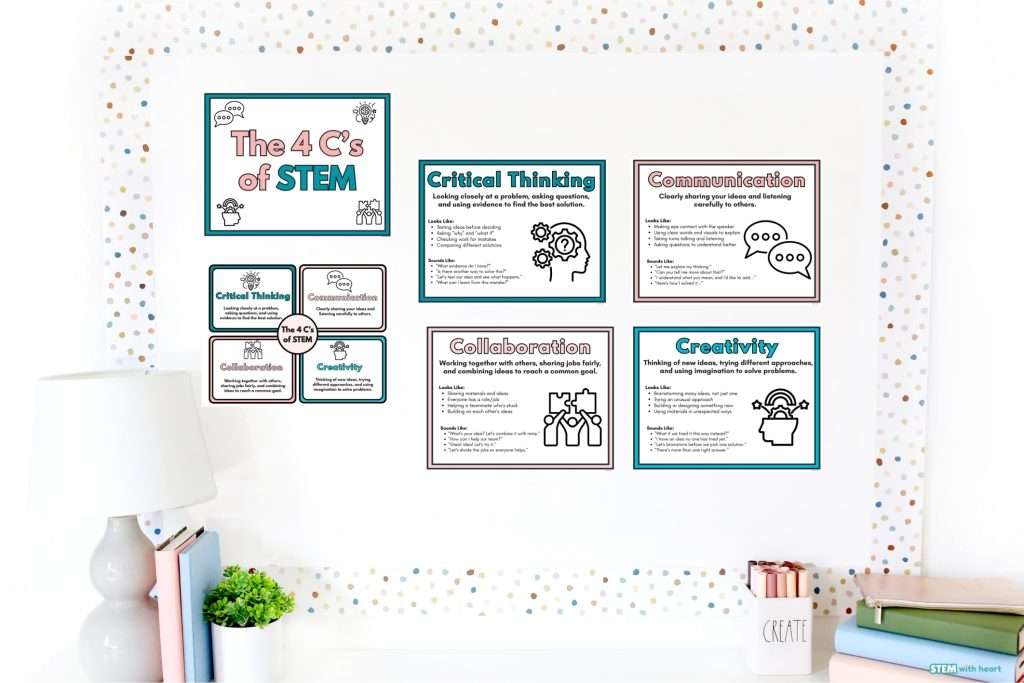
Here’s what I landed on. STEM is built on four skills, the 4 C’s: Critical Thinking, Collaboration, Communication, and Creativity. Not four subjects. Four habits that show up in every good lesson, no matter what you’re teaching.
Once you know what each one actually means, you start spotting them everywhere. Or noticing when they’re missing.
Key Takeaways
The 4 C’s are Critical Thinking, Collaboration, Communication, and Creativity. You don’t need a new curriculum to build them in, just small shifts in how you ask questions and design tasks. The World Economic Forum’s 2025 Future of Jobs Report lists creative and analytical thinking among the fastest-growing skills employers need through 2030. The habits we build in elementary school matter more than ever.
Table of Contents
Why the 4 C’s Matter
The 4 C’s aren’t just an education buzzword. They’re the skills employers say they can’t find enough of.
The World Economic Forum surveyed over 1,000 of the world’s largest employers for its 2025 Future of Jobs Report. Analytical thinking, creative thinking, and collaboration came out on top. By 2030, nearly 39% of workers’ core skills are expected to shift. The exact jobs our students will have might not exist yet. But the thinking habits behind them? We can start building those now. With a tower challenge and one good question.
What Are the 4C’s of STEM?
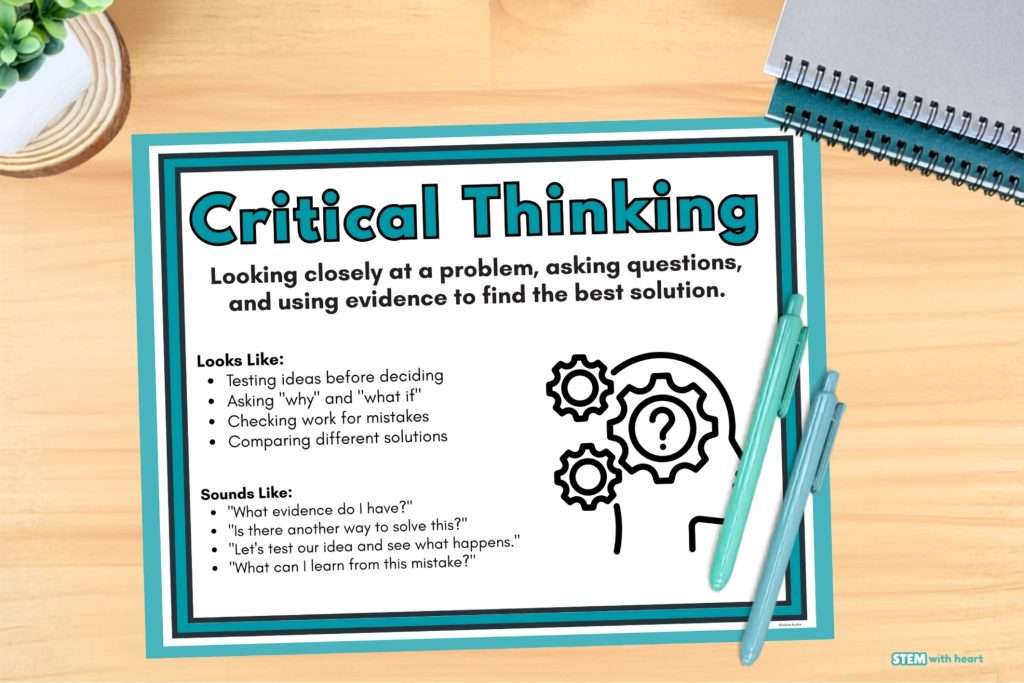
Critical Thinking: Asking “Why” Before “What Now”
Critical thinking isn’t just solving a problem. It’s pausing to ask why something happened before jumping to what to do next.
Picture a student whose tower keeps falling. Instead of grabbing more tape, they stop and ask: is it the base, or the height? That pause is critical thinking in action.
Back in the lab, we called this the scientific habit of mind. You don’t just rerun the experiment. You ask why it failed first. Same idea here, just with shorter people and more glue sticks.
Try This: Instead of telling students why their bridge design failed, ask: “What do you notice? What do you think caused that?” Then wait. Let them investigate before you explain.
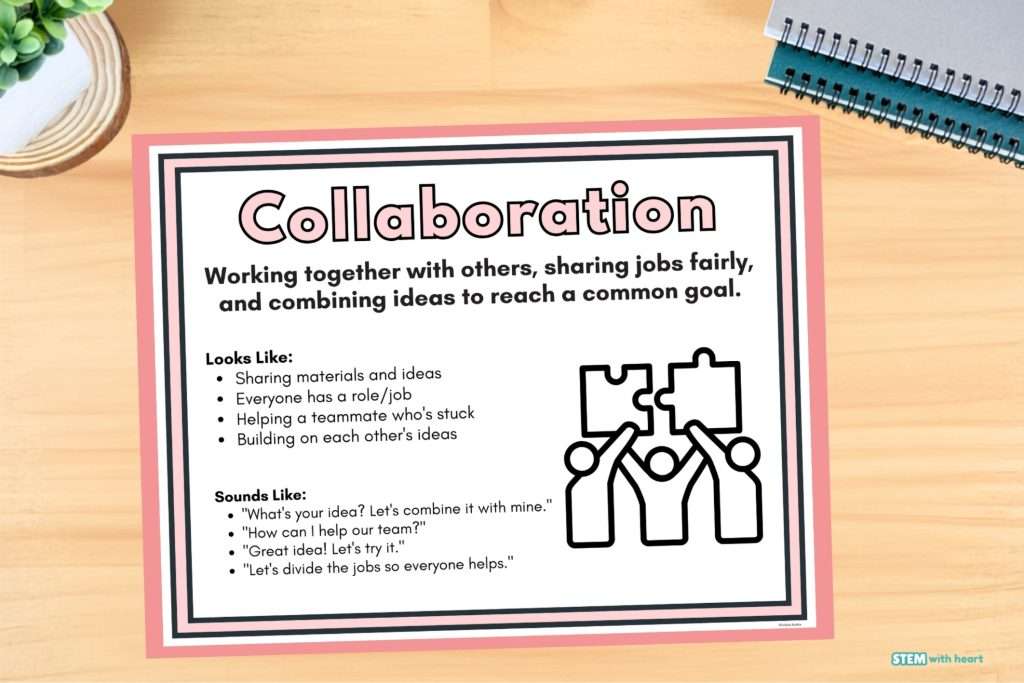
Collaboration: Building Ideas Together, Not Just Sitting Together
Group work and collaboration aren’t the same thing. I say that with love, because I used to call them the same thing. They’re not.
Real collaboration means students build on each other’s thinking. Not divide up the worksheet and work solo at the same table.
Here’s the part that surprised me. When kids actually have to depend on each other, they start liking each other more too. I expected the academic payoff. I didn’t expect the friendship one.
Try This: Assign roles that require real interdependence: Team Captain, Resource Manager, Analyst, Builder. No one can finish without the others contributing actual thinking, not just supplies. This is the backbone of my STEM Team Roles resources
More on how this works in practice: STEM Team Roles for Upper Elementary
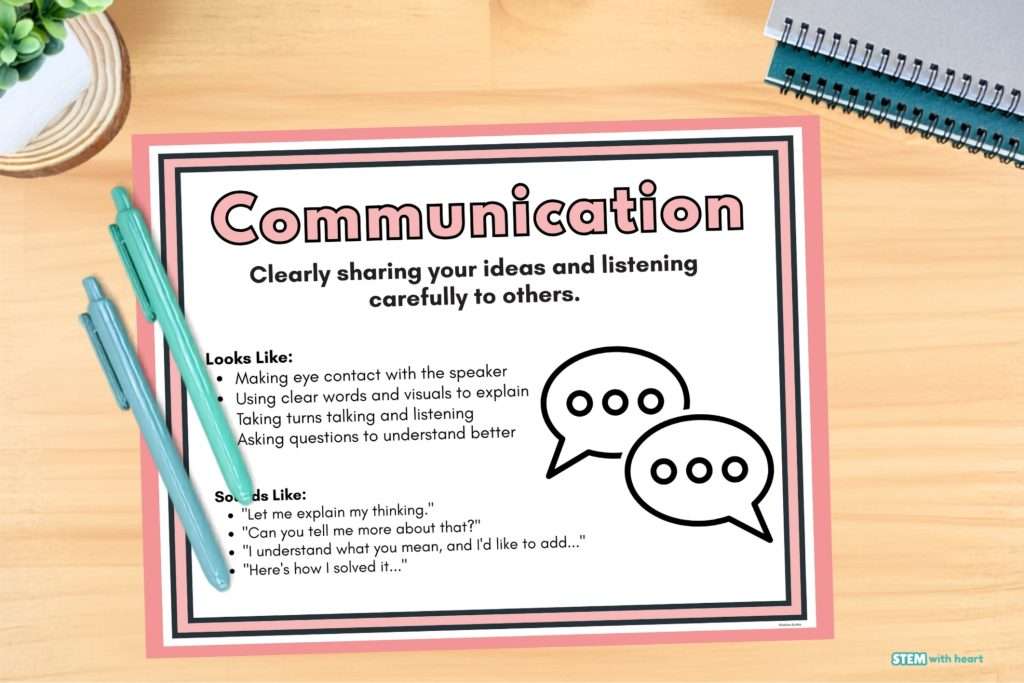
Communication: Explaining Their Thinking, Not Just Their Answer
A student who says “42” isn’t necessarily communicating. Communication means explaining how they got there. Out loud, in writing, or through a model.
This one slows things down, and that’s the point. Checking an answer takes five seconds. Explaining the process takes longer, but that’s where the actual learning shows up.
There’s a bonus skill hiding in here too. Explaining your design to a teacher sounds different than explaining it to a classmate. Kids who practice that flexibility carry it for life.
Try This: After a task card or experiment, have students explain their process to a partner before you check the answer together. Or try teach-back: pairs explain their thinking to another pair. Teaching something is the best way to find out if you actually understand it.
More on this here: The Power of Reflection in STEM Learning
Creativity: More Than One “Right” Way to Solve It
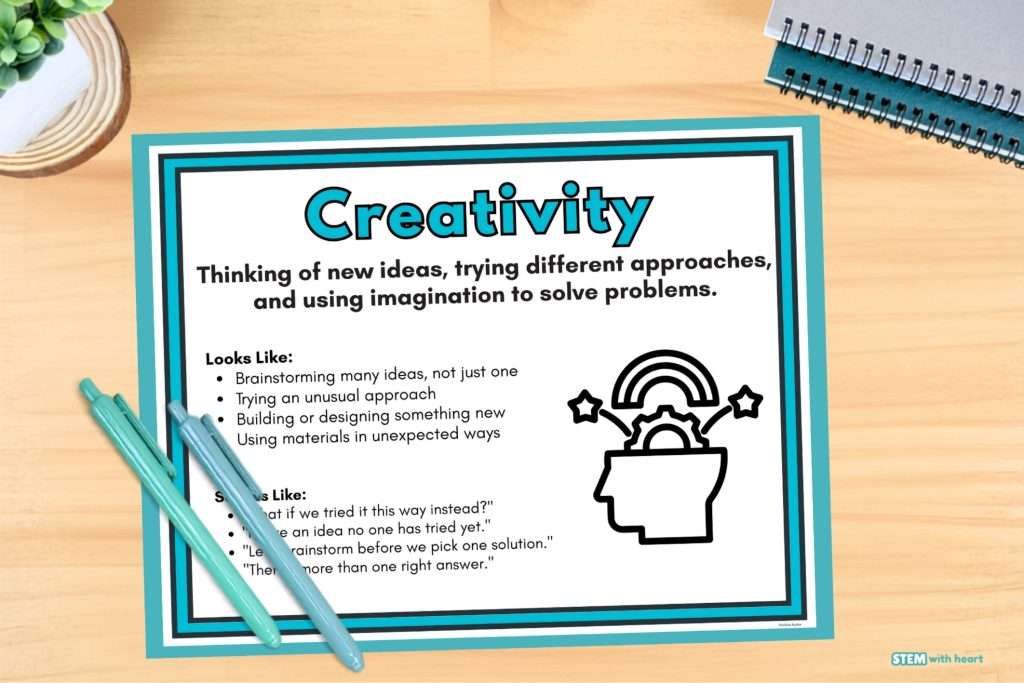
Creativity in STEM doesn’t mean arts and crafts. It means leaving room for more than one valid solution.
If every student’s project looks identical, there probably wasn’t much room for creativity baked in.
I’ve seen this get squeezed out two ways. Too many steps, so there’s no room left for kids to decide anything. Or kids sensing there’s one right answer, so they stop offering different ideas. Creativity needs room to be wrong on the way to being right.
Try This: Give the constraint, not the method. “Build a structure that holds a textbook” works. “Build it exactly like this” doesn’t. Let five different solutions sit side by side. That’s the lesson right there: more than one way works.
You Don’t Need a New Unit
Here’s what I kept rediscovering as a classroom teacher. The 4 C’s don’t need a new unit. They need a shift in how you run the lessons you already have.
Ask one more “why” before you explain. That’s critical thinking. Assign roles that force real interdependence. That’s collaboration. Make them explain before they answer. That’s communication. Loosen the method and let multiple answers work. That’s creativity.
Small shifts. Real impact. No new binder required.
And they feed each other. Kids who think critically ask better questions. Better questions make better communicators. Better communicators make stronger collaborators. Stronger collaborators take more creative risks, because the group has their back. It’s less a checklist, more a chain reaction.
Classroom Resource: Want a visual reminder of the 4 C’s on your wall? My 4 C’s of STEM Poster Set pairs with my ABCs of STEM Alphabet Posters. Links below.
➡️ ABCs of STEM Alphabet Posters
Quick Questions About the 4 C’s of STEM
What exactly are the 4 C’s of STEM?
Critical Thinking, Collaboration, Communication, and Creativity. They’re the habits of mind STEM is meant to build: analyzing problems, working with others, explaining your thinking, and coming up with original solutions.
How are the 4 C’s different from regular STEM skills?
Content is what students learn. The 4 C’s are how they learn to think. Content changes by grade and subject. The 4 C’s carry over. A kid who learns to think critically building a tower in third grade uses that same skill years later, in a lab, in a job, wherever.
Can I build these in without redoing my whole curriculum?
Yes. That’s the good news. One extra “why do you think that happened” builds critical thinking. Interdependent roles build collaboration. Explaining before answering builds communication. Dropping the one-right-method builds creativity. Small, consistent moves add up.
What’s the difference between group work and collaboration?
Group work means kids are sitting together. Collaboration means they can’t finish without each other. If one student can complete their piece alone while everyone else catches up, that’s parallel work, not collaboration.
Why should elementary teachers care what employers want?
Because habits form early and stick. The World Economic Forum lists analytical thinking, creative thinking, and collaboration as core workforce skills through 2030. A kid who spends six years practicing these is more ready than one who learns them for the first time in a job interview.
Four Habits, Not Four Posters
I’ve seen the 4 C’s treated like a checklist. A box to tick. A poster above the whiteboard.
That’s not really what they are. They’re the answer to the question every STEM lesson should be asking. Not just “can my students finish this task,” but “what kind of thinkers are they becoming.”
You don’t have to hit all four every day. But if you’re regularly asking kids to pause before acting, depend on each other for real, explain their reasoning out loud, and solve problems their own way, you’re building something that lasts past one lesson.
That’s the kind of STEM teaching worth doing.