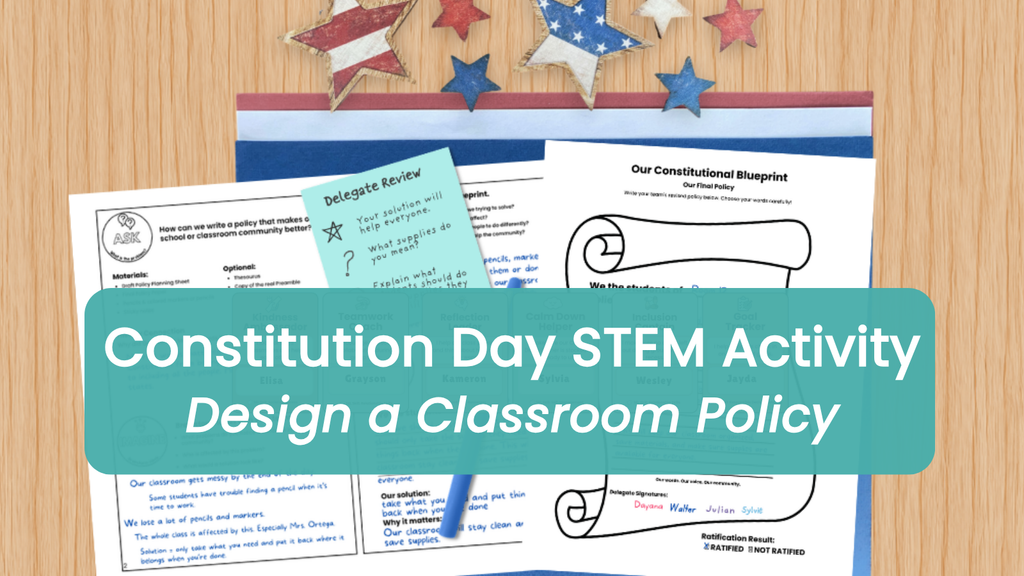
Constitution Day STEM Activity: Design a Classroom Policy
Looking for a Constitution Day STEM activity that goes beyond reading about the Constitution and answering a few questions?
Constitution Day is a great opportunity to help students see that the Constitution wasn’t simply a document that appeared fully formed. It was created through discussion, disagreement, compromise, revision, and some very careful choices about words.
And that process has a surprising amount in common with the Engineering Design Process.
This Constitution Day activity brings STEM, social studies, and SEL together as students learn about Gouverneur Morris, explore the power of words and ideas, and work through a design challenge of their own.
Instead of building a tower or bridge, they’ll be designing something different:
a classroom policy.
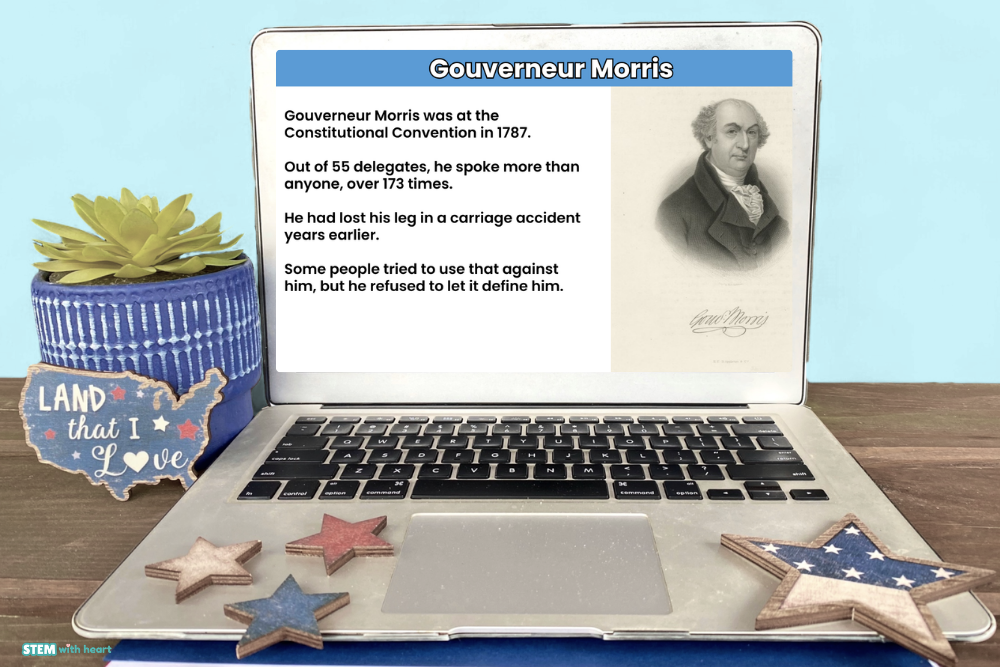
Who Was Gouverneur Morris?
When students learn about the Constitution, they probably hear familiar names like George Washington, James Madison, and Benjamin Franklin.
Gouverneur Morris may not be quite as familiar.
But he played an important role at the Constitutional Convention of 1787 and is generally credited with writing the final wording of the Constitution, including its famous opening:
“We the People…”
That’s a pretty powerful starting point for a classroom conversation.
Why do words matter?
How can the way we write an idea change how people understand it?
And how do we create rules and policies that are fair to the people who have to follow them?
Those questions lead perfectly into a STEM + social studies challenge.
Turning Constitution Day Into a STEM Challenge
In a traditional STEM challenge, students might be asked to design a structure, vehicle, or device.
But the Engineering Design Process can be used to solve more than physical design problems.
For this challenge, students become policy designers.
Their task is to identify a real classroom problem and design a policy that could help solve it.
Maybe students notice that classroom supplies aren’t always returned where they belong.
Maybe group work gets too noisy.
Maybe there’s confusion about what to do when someone finishes an assignment early.
Whatever problem they choose, their team has to develop a solution that is clear, realistic, and fair.
And just like engineers, they won’t stop with their first idea.
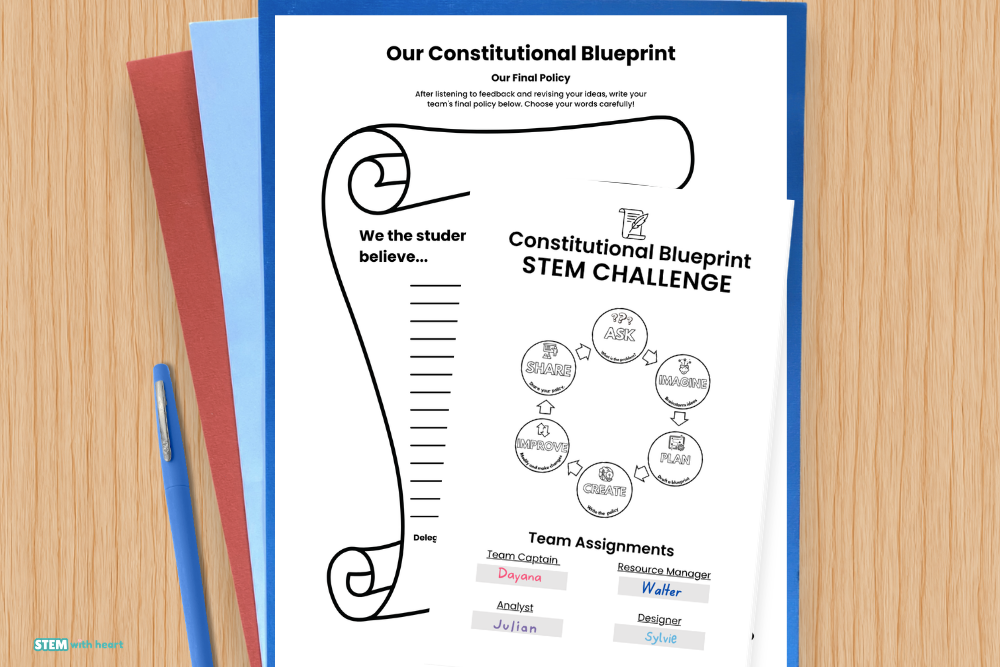
They’ll ask, imagine, plan, create, improve, and share.
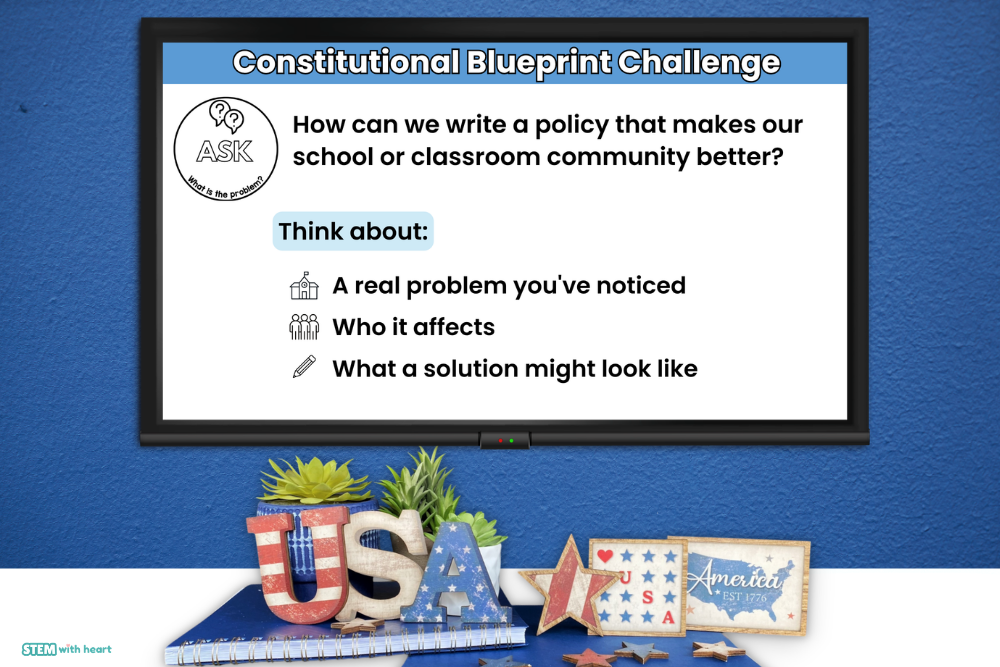
Step 1: ASK – Identify the Problem
Start by asking students to think about problems that affect their classroom community.
What could work better?
What causes frustration?
What makes it harder for everyone to learn or work together?
Teams choose one problem and clearly define it before trying to solve it.
This step is important because students often want to jump immediately to solutions.
Engineers learn to understand the problem first, and so do thoughtful leaders.
Step 2: IMAGINE – Brainstorm Possible Policies
Next, teams brainstorm different ways they could solve their classroom problem.
The goal isn’t to immediately choose the “best” idea.
It’s to generate possibilities.
Encourage students to consider questions like:
- Who would this policy affect?
- Would it be fair to everyone?
- Would students actually be able to follow it?
- Could it create a new problem?
- How could we make the idea better?
This is also a great opportunity to reinforce that disagreement doesn’t mean a team isn’t working well.
Different ideas can actually lead to stronger solutions.
Step 3: PLAN – Choose and Develop an Idea
After brainstorming, students choose the idea they think has the most potential.
Now they need to turn that idea into an actual policy.
Their policy should clearly explain what students should do and how it will help solve the original problem.
This is where the connection to Gouverneur Morris becomes especially meaningful.
Words matter.
Students have to think carefully about whether their policy says what they actually intend it to say.
Step 4: CREATE – Draft the Policy
Now teams create their first policy draft.
This is their prototype.
Instead of testing whether a bridge holds weight or a tower stays standing, students test whether their idea holds up.
Is the policy clear?
Is it specific enough?
Could someone misunderstand it?
Is it realistic?
Is it fair?
Students quickly discover that designing with words can require just as much problem solving as designing with materials.
Step 5: IMPROVE – Hold a Mini Convention
Here’s where the activity really starts to feel like Constitution Day.
Teams participate in their own mini Convention.
They present their draft policies, listen to feedback, ask questions, and consider other perspectives.
Then they return to their drafts and make improvements.
Students might clarify confusing language, adjust an unrealistic expectation, or change part of their policy after hearing a perspective they hadn’t considered.
It’s a concrete way for students to experience an important idea:
Good solutions often get better through feedback and revision.
Step 6: SHARE – Present the Final Policy
Once teams have revised their policies, they prepare to share their final versions.
Students explain:
- the classroom problem they identified,
- the policy they designed,
- how the policy would help,
- and any changes they made after receiving feedback.
This gives students practice communicating not only their final answer, but also the thinking behind it.
Step 7: RATIFY – Let the Class Decide
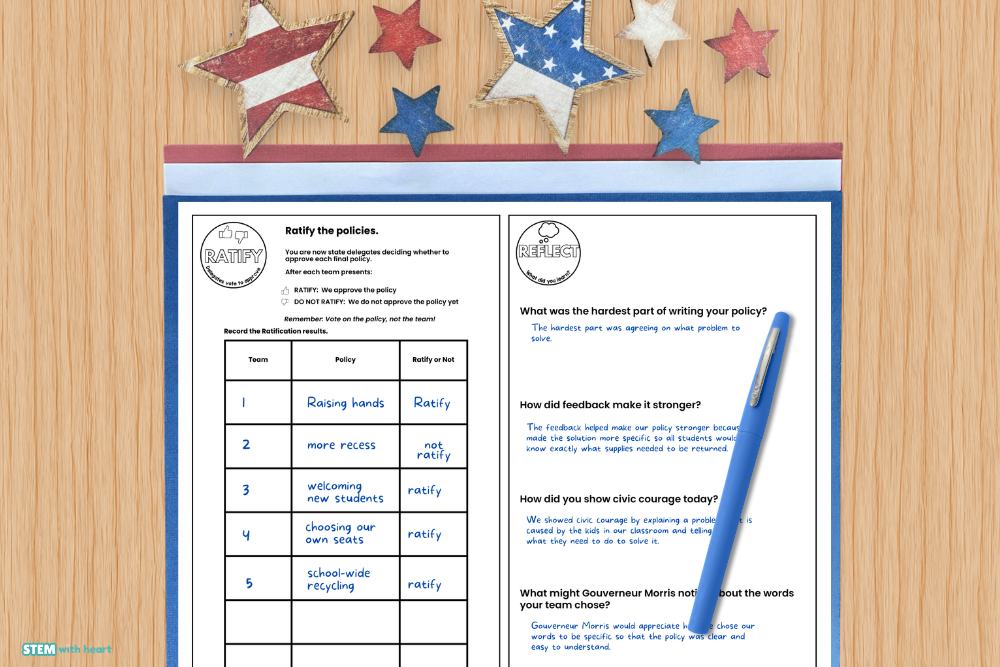
Finally, it’s time to vote.
After the final policies have been presented, students decide whether each should be ratified.
A policy is ratified if it receives the agreed-upon majority of votes.
Suddenly, the vocabulary students encounter when learning about the Constitution has a concrete classroom meaning.
They haven’t just read the word ratify.
They’ve experienced the process.
The SEL Connection: Using Your Voice
One of my favorite parts of this Constitution Day STEM activity is that it creates a natural connection to social-emotional learning.
Students have to share ideas, listen to other perspectives, disagree respectfully, respond to feedback, and advocate for ideas they believe will improve their classroom community.
It also opens the door to talking about the power of using your voice.
Gouverneur Morris used words to help communicate ideas that would become part of one of the most important documents in American history.
Our students need opportunities to discover that their words have power, too.
They can identify problems.
They can contribute ideas.
They can listen to others.
And they can use their voices to help make their communities better.
Why Combine STEM and Social Studies?
STEM doesn’t have to live in its own little box on the classroom schedule.
Some of the best STEM learning happens when students use the Engineering Design Process to think about problems in a completely different context.
In this activity, students aren’t just learning facts about the Constitution.
They’re practicing:
- problem solving,
- collaboration,
- communication,
- revision,
- decision making,
- perspective taking,
- and responsible participation in a community.
They’re learning about history and doing something with what they’ve learned.
That’s the kind of cross-curricular learning I want students to remember.
Try the Gouverneur Morris Constitution Day STEM Challenge
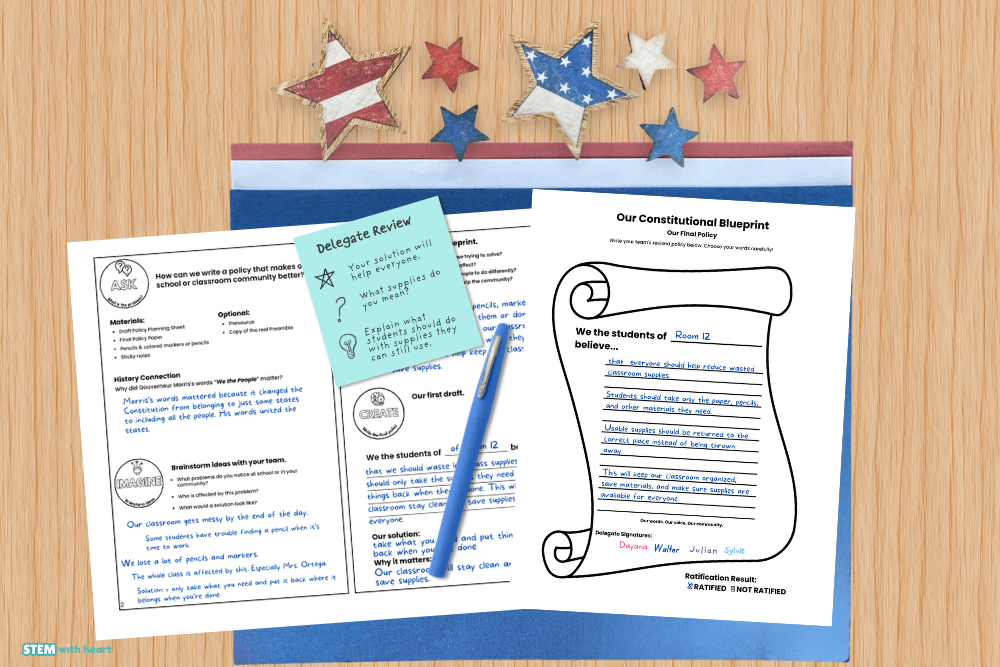
If you’d like to teach this activity without creating all of the pieces yourself, I’ve put together a complete Gouverneur Morris Constitution Day STEM + Social Studies Challenge for upper elementary students.
It walks students from the mini-lesson about Gouverneur Morris through the entire policy design challenge, including the Engineering Design Process, Convention, final policy, ratification, and reflection.
It’s designed to give you the structure you need while leaving the thinking, discussing, designing, and decision making to your students.
➡️ Explore the Gouverneur Morris STEM + Social Studies Challenge
And if you’re working on collaboration during STEM this fall, you might also like my free STEM Team Roles. They’re an easy way to give every student a meaningful role and make group work feel a little less chaotic.
➡️ Grab the Free STEM Team Roles
Constitution Day doesn’t have to be another day of reading a passage and answering questions.
Give students a problem to solve, a voice in the process, and a chance to experience how ideas can be discussed, revised, and improved.
They might just walk away understanding “We the People” a little differently.
With heart,