STEM activities are supposed to be collaborative.
Give students a challenge, put them into teams, hand out the materials, and watch them work together to solve the problem.
At least, that’s how it goes in the lesson plan.
In reality? One student grabs all the materials. Another insists their idea is the only idea. Someone else quietly checks out of the activity altogether. And before long, you’re hearing:
“She’s not listening to me!”
“He won’t let me do anything!”
“They ruined our design!”
If you’ve been there, you’re definitely not alone.
The good news is that STEM gives us an incredible opportunity to teach teamwork instead of simply expecting it.
With a few intentional strategies, STEM teamwork activities can help students practice communication, collaboration, problem-solving, and even conflict resolution—all while they’re designing and building.
Here are some of my favorite ways to make that happen.
1. Teach Teamwork Before the STEM Challenge Begins
We often spend plenty of time teaching the academic part of a STEM challenge but very little time teaching students how to work together during it.
Before students ever touch the building materials, talk about what successful teamwork actually looks and sounds like.
Ask students:
- What does a good teammate do?
- What does a good teammate say?
- What should happen when two people have different ideas?
- How can everyone contribute?
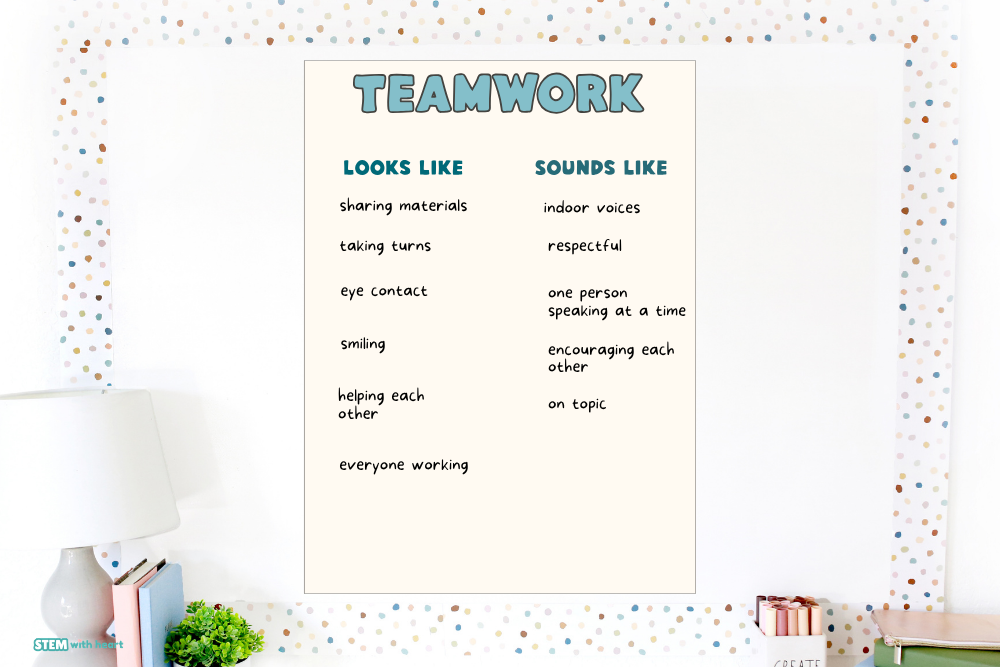
You might even create a quick class anchor chart with two columns:
Teamwork Looks Like…
and
Teamwork Sounds Like…
Students might suggest things like sharing materials, taking turns, asking questions, encouraging teammates, listening to everyone’s ideas, and disagreeing respectfully.
This doesn’t need to become a separate 30-minute lesson. Even five minutes spent establishing expectations can make the actual STEM challenge run much more smoothly.
Collaboration is more than a STEM skill. it also gives students opportunities to practice communication, cooperation, and problem-solving, all of which connect naturally with social-emotional learning and relationship skills.
2. Give Every Student a Meaningful Role
One of the easiest ways to improve teamwork during STEM activities is to give students specific responsibilities.
Without defined roles, students often fall into predictable patterns. Your confident builders take over while quieter students end up watching.
Team roles help change that.
Depending on the activity, students might be responsible for managing materials, recording ideas, keeping the team focused on the criteria and constraints, or helping coordinate the building process.
The key is making sure the roles involve real responsibilities.
A role shouldn’t mean one student does all the building while everyone else watches.
I also like rotating roles from one STEM challenge to the next. The student who naturally wants to be the builder may need practice listening, recording, organizing, or managing resources too.
That’s part of the learning.
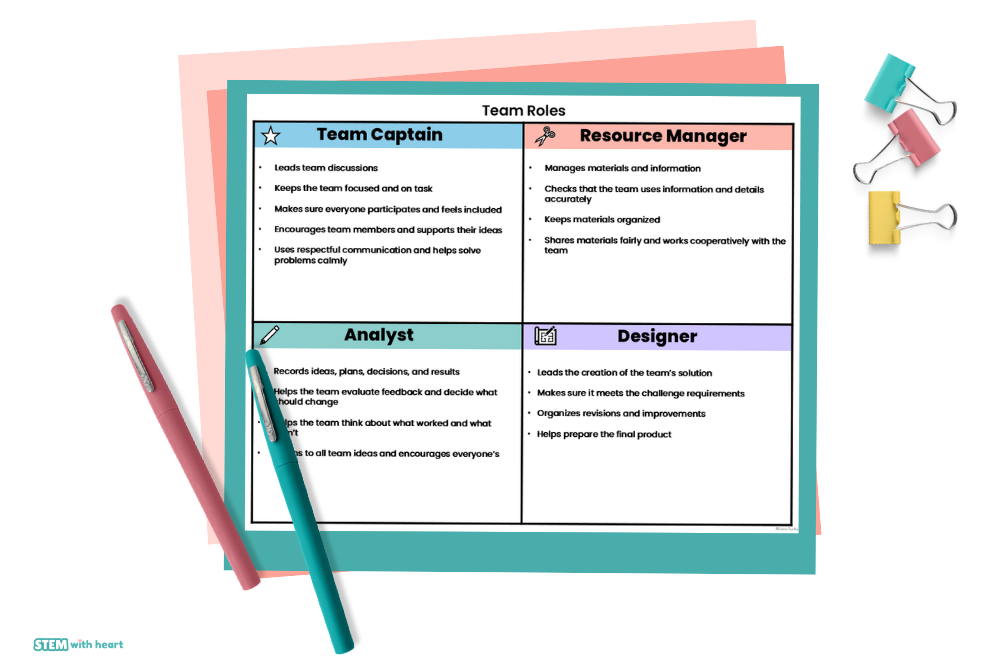
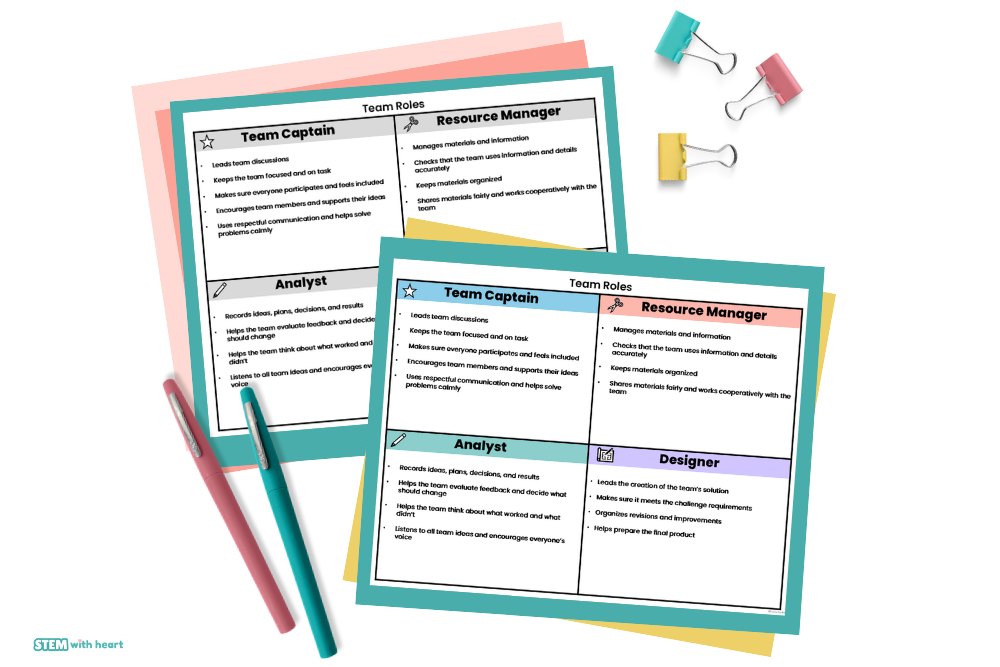
FREEBIE IDEA: My STEM Team Roles Cards make it easy to establish clear responsibilities during group STEM challenges, get them here.
3. Build “Everyone Has a Voice” Into the Planning Process
The planning stage is one of the best places to prevent teamwork problems before they start.
Instead of immediately asking teams to agree on one design, give each student a chance to contribute an idea first.
For example:
- Give students a minute or two to think or sketch independently.
- Have each team member share their idea.
- Ask the group to identify something they like about each suggestion.
- Then have the team create its final plan.
This small change makes a big difference.
Students who tend to dominate have to slow down and listen. Students who are more hesitant have a built-in opportunity to contribute.
It also reinforces an important part of the engineering design process: the first idea isn’t necessarily the best idea.
Great designs often come from combining and improving multiple ideas.
4. Give Students Language for Disagreeing
Disagreement isn’t a sign that a STEM team isn’t working.
In fact, disagreement is often part of good problem-solving.
The goal isn’t to eliminate conflict. It’s to teach students what to do when it happens.
Instead of:
“That’s a bad idea.”
Students can learn to say:
“Can you explain why you think that will work?”
“What if we tried…?”
“I see your idea. I’m wondering if…”
“Could we combine our ideas?”
“Let’s look at the criteria again.”
Simple sentence stems can be especially helpful for upper elementary students who know they’re frustrated but don’t always have the language to express that frustration productively.
This is where STEM and social-emotional learning fit together so naturally. Students aren’t just designing a tower, bridge, or catapult. They’re practicing how to listen, communicate, compromise, and solve problems with other people.
5. Normalize Failure Before Something Fails
Nothing tests teamwork quite like watching the structure you’ve spent 20 minutes building collapse.
Suddenly:
“I told you that wouldn’t work!”
STEM challenges give students lots of opportunities to experience frustration, which also means they give us lots of opportunities to teach students how to respond to it.
Before testing begins, remind students that the goal isn’t to create a perfect design on the first try.
The goal is to:
Create → Test → Learn → Improve
When something doesn’t work, encourage teams to shift from blame to curiosity.
Instead of:
“Whose fault was it?”
Try:
“What did we learn from that test?”
“What part worked?”
“What could we change?”
“What should we try next?”
That simple shift keeps students focused on solving the problem rather than solving who caused the problem.
If STEM frustration tends to turn into bigger reactions in your classroom, you may also like A 3-Step Framework for Managing STEM Meltdowns.
6. Don’t Make the Winning Design the Only Measure of Success
If the tallest tower or strongest bridge is always the definition of success, students quickly learn that the final product matters more than the process.
But some of the best teamwork may happen in the group whose tower falls over.
Consider recognizing things like:
- Strong communication
- Creative problem-solving
- Perseverance
- Everyone contributing
- Respectful disagreement
- Thoughtful improvements
- Flexibility when an idea doesn’t work
You can also include these skills in your STEM rubric or student self-assessment.
This sends an important message:
How we work together matters just as much as what we build.
7. End STEM Teamwork Activities With Reflection
This may be my favorite part, and it’s also one of the easiest to skip when you’re running out of time.
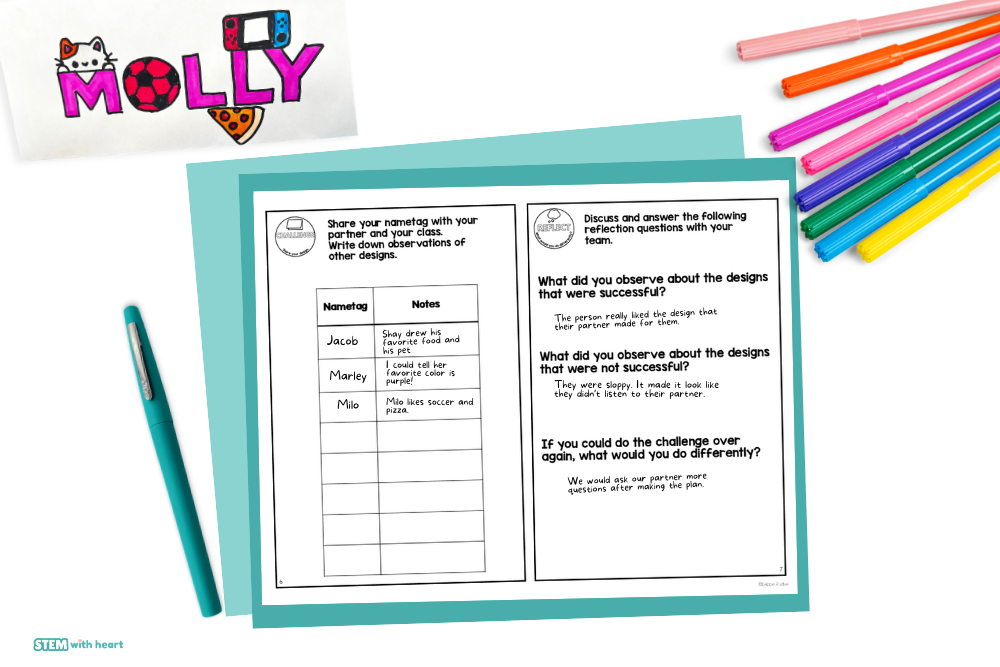
After the challenge, ask students to reflect on the teamwork, not just the design.
Try questions like:
- What did our team do well today?
- How did I contribute to my team?
- When did we disagree? How did we handle it?
- Did everyone have a chance to share ideas?
- What would I do differently during our next STEM challenge?
Even a two-minute exit ticket can help students recognize that collaboration is a skill they can improve.
Over time, students start noticing their own teamwork habits.
And that’s where the real growth happens.
STEM + SEL: Teaching More Than Engineering
STEM teamwork activities can teach so much more than science, technology, engineering, and math.
Every time students plan a design together, disagree about an idea, recover from a failed test, encourage a frustrated teammate, or decide what to try next, they’re practicing skills they’ll use far beyond the STEM classroom.
The trick is not assuming those skills will develop automatically.
Teach them. Practice them. Reflect on them.
When we make teamwork part of the learning goal, not just the way students are grouped, STEM becomes an incredibly powerful place to build collaboration, communication, perseverance, and problem-solving.
And your STEM challenges may just run a little more smoothly, too.
Ready to put those teamwork skills into practice?
Give students a hands-on opportunity to practice communication, collaboration, and problem-solving with the Paper Chain STEM + SEL Teamwork Challenge. Students work together through the engineering design process while reflecting on how their team worked, not just what they built.
Remember, strong STEM teamwork doesn’t happen overnight. Start by giving students clear expectations and a meaningful role on their team. My FREE STEM Team Role Cards make it easy to put the strategies from this post into practice during your very next STEM challenge.
Here’s to more teamwork, fewer STEM meltdowns, and lots of proud “we did it!” moments.
Happy teaching!