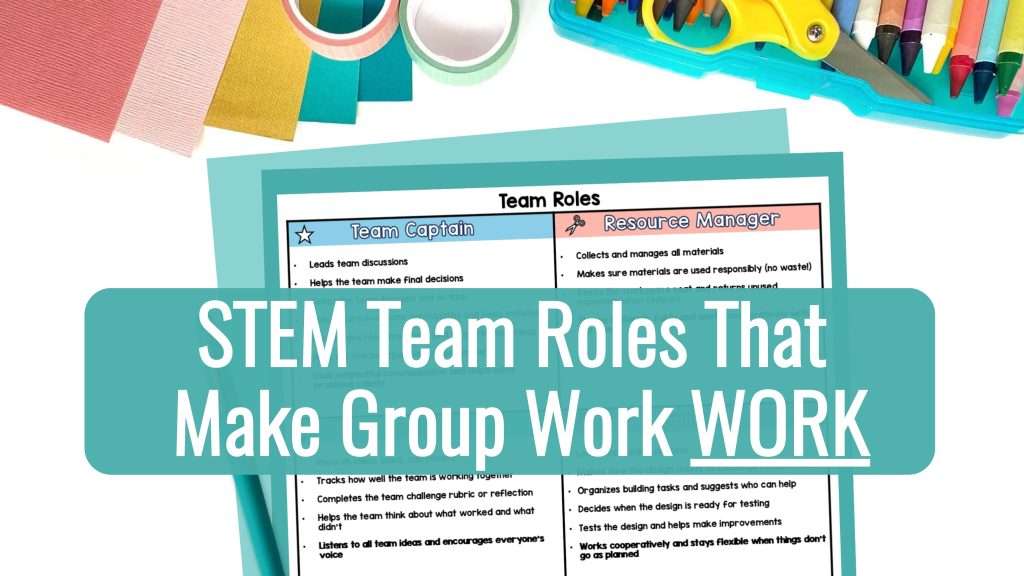
If you’ve ever watched a STEM challenge go sideways , one student taking over, another checking out completely, the whole group arguing about who gets to hold the tape, you already know the problem.
It’s not the kids. It’s the structure.
Or rather, the lack of it.
When students don’t have clear STEM team roles going into a challenge, they default to whatever comes naturally: the natural leaders take charge of everything, the quieter kids fade into the background, and the whole “collaborative” part of STEM kind of falls apart.
The fix is simpler than you’d think: defined team roles.
In this post, I’m sharing the exact four-role system I use in my own classroom , what each role does, why it works, and how to start using it right away (even if you’ve never tried structured roles before).
📌 Want the printable role cards and full-page reference sheets? Grab the free download below!
Why STEM group work breaks down (and what to do about it)
Here’s something I had to learn the hard way: STEM group work doesn’t fail because of bad behavior.
It fails because students don’t have a clear answer to the question, “What am I supposed to be doing right now?”
Without structure, groups naturally fragment. One student fills every role. Others lose their sense of purpose. The “team” becomes one person’s project with three observers.
And when students feel frustrated, overwhelmed, or unsure, those big emotions can take over fast. That’s why having supports in place for emotional regulation matters just as much as having clear roles. If you’re seeing those moments in your classroom, setting up a calm down corner that actually works can give students a way to reset and come back ready to contribute.
Defined roles give every student a job that’s theirs to own, and that changes everything. When the Builder knows they’re in charge of construction, the Team Captain isn’t stepping on their toes. When the Resource Manager owns the materials, there’s no grabbing or hoarding. When the Analyst is tracking ideas, quieter students have a meaningful way to contribute that doesn’t require elbowing their way in.
Everyone has a seat at the table.
Everyone has a purpose.
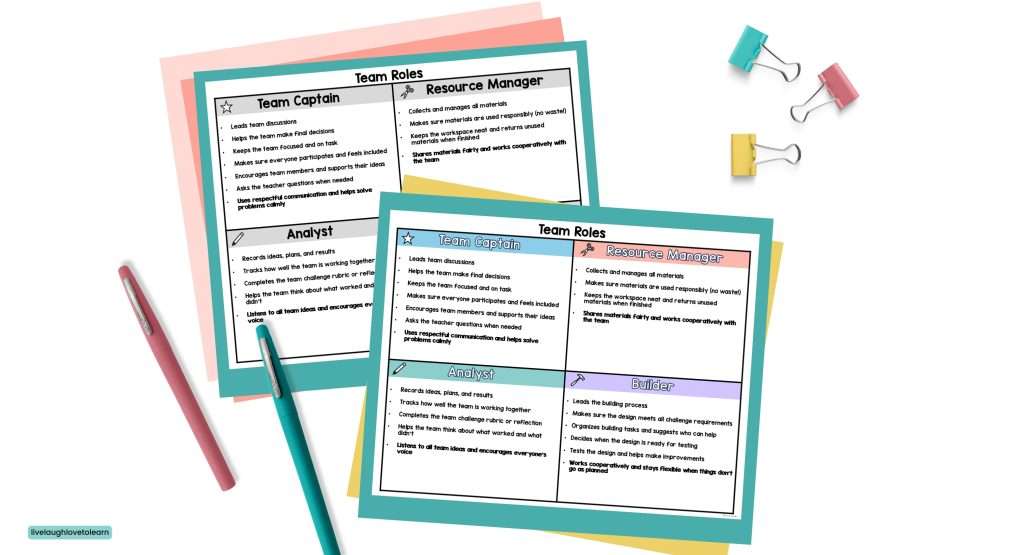
The four STEM team roles (and what they actually do)
Here’s a breakdown of the four roles I use, and why each one matters.
⭐ Role 1: Team Captain
Leads team discussions, keeps the group focused and on task, makes sure everyone participates, and asks the teacher questions when needed. Uses respectful communication and helps solve problems calmly.
✂️ Role 2: Resource Manager
Collects and manages all materials, makes sure they’re used responsibly, keeps the workspace tidy, and returns unused supplies. Shares materials fairly and works cooperatively with the team.
✏️ Role 3: Analyst
Records ideas, plans, and results. Tracks how well the team is working together, completes the reflection rubric, and helps the team think through what worked and what didn’t. Listens to all ideas and encourages everyone’s voice.
🔨 Role 4: Builder
Leads the building process, makes sure the design meets the challenge requirements, organizes building tasks, decides when the design is ready for testing, and helps make improvements. Stays flexible when things don’t go as planned.
Notice that each role ends with a social-emotional expectation. This is intentional. The roles aren’t just task assignments, they’re also practice for the kind of collaborative skills students will use for the rest of their lives.
If you’re looking for more ways to intentionally build these skills into your lessons, I share additional ideas in my post on how to add social-emotional learning to any STEM challenge.
How to introduce roles in your classroom
You don’t need a whole unit to get started. Here’s how I recommend rolling this out:
1. Introduce one role at a time.
Don’t hand out all four cards on day one and expect instant buy-in. Spend a few minutes spotlighting one role per challenge at the start. By the time you’ve cycled through all four, students have a real feel for each one.
2. Model what each role looks like.
Yes, even if it’s a little silly, especially if it’s a little silly. Do a quick demo: show what a Team Captain sounds like when the group disagrees. Show what the Resource Manager does when someone tries to grab extra supplies. A 3-minute model is worth 30 minutes of redirecting later.
3. Assign roles before you hand out materials.
This is the step most teachers skip. If roles are announced after materials are distributed, the building has already started and no one is listening. Announce roles first. Every time.
4. Do a mid-challenge check-in.
About 10 minutes in, pause the room for 60 seconds. “Resource Managers, how’s your workspace? Analysts, are you tracking what’s happening?” It resets groups, reinforces the roles, and reminds students they have a job to do.
5. Rotate roles between challenges.
Students who always default to “doer” get to practice leading. Students who tend to hang back get a turn at the front. Over time, every student gets stronger in every role.
Once students understand their roles, the real magic happens when they apply them during hands-on learning. STEM challenges are the perfect opportunity for students to practice communication, problem-solving, and teamwork in a meaningful way.
You can see how this looks in action in these hands-on Earth Day STEM challenges for upper elementary students.

A few things teachers always ask:
What if I only have groups of 3?
Easy, combine the Team Captain and Analyst roles. The Captain can handle the leadership piece while also keeping notes and completing the reflection. It works seamlessly.
Do I need to use all four roles every time?
Nope. For shorter challenges or introductory activities, even using just two roles (Team Captain and Builder) gives students enough structure to make a real difference.
How long does it take for roles to really click?
In my experience, by the third or fourth challenge students start owning their roles without much reminding. The first time is the hardestm after that, it gets easier every single time.
Want a printable version of the Team Roles?
Hit the button below and I’ll send the Team Roles set straight to your inbox.
Your students are ready for this. Grab the free STEM Team Roles set, printable cards and full-page posters for all four roles, ready to use with your very next challenge.
The bottom line
Structured roles won’t solve every challenge that goes sideways, but they eliminate the most common reason STEM group work breaks down.
When every student walks in knowing their job, your job gets a whole lot easier.
Start small. Try one role in your next challenge. See what shifts.
I think you’ll be surprised.