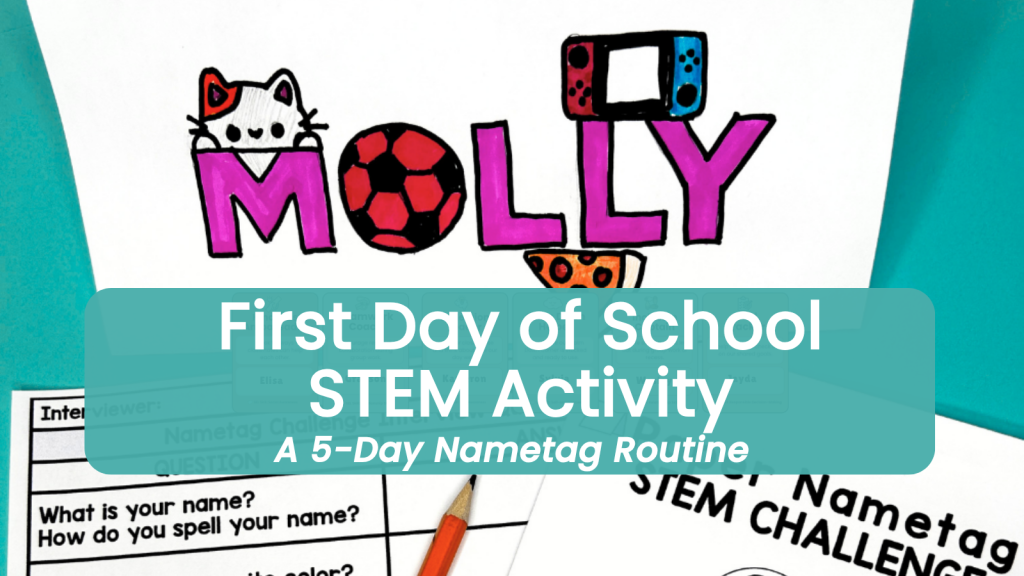
It’s 8:15 on the first day of school. Twenty-two kids are standing in a room they’ve never been in, next to people they may or may not know, waiting for someone to tell them what to do. You’ve got a stack of blank nametags and fifteen minutes before your first real lesson starts.
Here’s the trap most of us fall into: we treat that fifteen minutes as a throwaway. Kids color a nametag, maybe say their name out loud once, and it goes on a desk. It’s fine. It’s also a missed opportunity, because that same fifteen minutes, done differently, can start teaching your students how to talk to each other, listen to each other, and work as a class. Not someday. Day one.
This nametag routine is a first day of school STEM activity that does something most day-one activities don’t: it keeps working all week
A STEM + SEL nametag routine turns a housekeeping task into a five-minute, no-prep daily practice in speaking, listening, and classroom community, and it works because it repeats.
Instead of a single icebreaker that’s over by 8:30 and forgotten by lunch, students use the same nametag they made on day one as a conversation tool all week: new partner, new prompt, same quick structure, every day.
Want the full 5-day routine? Jump to the free download ⬇️
Key Takeaways
- A repeating routine builds speaking and listening skills far better than a one-time icebreaker, practice, not novelty, is what makes a skill stick.
- SEL isn’t a separate subject you have to squeeze in. It can live inside a routine you’re already running.
- The research is clear: classroom community and SEL competencies built early in the year help students feel included and welcomed immediately upon entering the room.
- Turn-and-talk style structures work because they let children practice conversational skills on a small, low-stakes scale.
- This routine takes 5 minutes, needs zero extra prep after day one, and can be reused any time you need a quick reset, not just in August.
Why Does the First Day of School Matter So Much for Classroom Community?
There’s a reason so much energy goes into the first day: it sets the tone for everything after it. Social and emotional learning builds community and fosters collaboration in learning spaces, and that work can begin the very first day of classes. Students form their first impressions of the room, whether it’s safe, whether they belong, whether people here actually talk to each other, almost immediately.
CASEL (the Collaborative for Academic, Social, and Emotional Learning) frames this around five core competencies: self-awareness, social awareness, responsible decision making, relationship skills, and self-management. A nametag routine touches more of those than you’d expect. Talking about a symbol you chose is self-awareness. Listening to a partner and then introducing them to the class is relationship skills and social awareness at the same time.
This isn’t just a nice-to-have. SEL interventions that address the five core competencies have been shown to increase students’ academic performance by 11 percentile points compared to peers without that instruction, a finding that’s held up across a landmark meta-analysis of 213 school-based programs involving more than 270,000 K–12 students. That’s not a small effect for something that costs five minutes a day and zero dollars.
Why This First Day of School STEM Activity Also Builds SEL Skills
If you’re a STEM teacher, “SEL routine” might sound like something else to do, [sigh].
It isn’t, because the same skills that make a good scientist or engineer are the skills this routine practices: explaining your thinking out loud, listening closely enough to introduce someone else’s idea accurately, and communicating clearly under a time limit.
To learn more about how STEM skills and SEL are connected, read my post about The 4C’s of STEM – Explained Without the Jargon.
Structured partner talk has a long track record here. The turn-and-talk routine increases students’ opportunities to respond, in a traditional classroom, the teacher asks a question and one student answers, but when every student has a partner, all of them get to think and talk. And it’s not just talk for talk’s sake: structured partner work has also been shown to increase on-task behavior, including for students who tend to struggle with sustained attention and focus.
There’s a reliability piece too, one that matters more than people expect. Having a consistent turn-and-talk partner helps build strong relationships, as time goes on, partners open up more, ask better questions, and learn to build on each other’s thinking. A nametag routine that rotates partners daily gets you the opposite benefit: kids build that same comfort with speaking and listening, but across the whole class, not just one seatmate, by the end of the week.
Practicing collaboration and teamwork skills is such an important part of STEM learning. Learn more about how I use STEM Team Roles to make group work work.
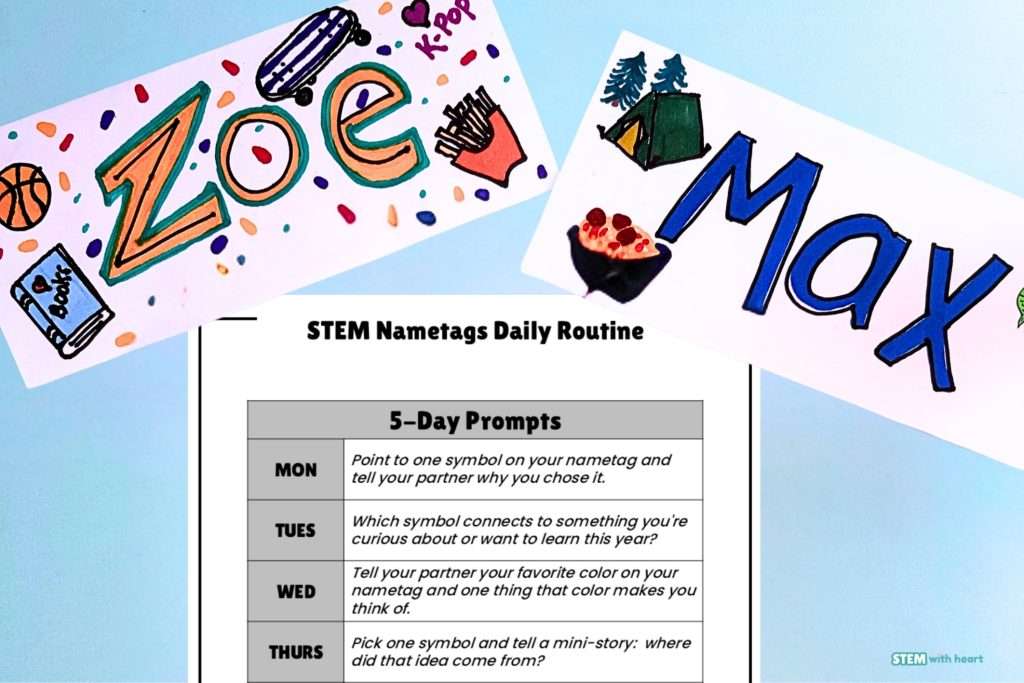
The Reframe: Why Most Nametag Activities Miss the Point
Here’s the thing almost nobody says out loud about first-day activities: most of them are designed to be forgotten. Make a nametag, do an icebreaker, move on. It’s a nice five minutes and then it’s over, no different from a party favor.
The shift that actually changes outcomes isn’t a better one-time activity. It’s turning the nametag into a routine instead of an event. Same format every day: grab your tag, find a new partner, answer that day’s prompt, a few pairs share out. Five days, five prompts, one repeating structure kids can predict and lean into.
That predictability is the whole point. Kids don’t have to relearn the rules each morning, they already know what’s coming, so all their effort goes into the actual talking and listening instead of figuring out the activity. By Thursday or Friday, you’re not running an icebreaker anymore. You’re running a habit. And habits are what actually build a classroom community, not the one big activity on day one, but the small thing you do on purpose, every day, until it’s just how your room works.
Try It Yourself: A 5-Day Speaking & Listening + SEL Nametag Routine
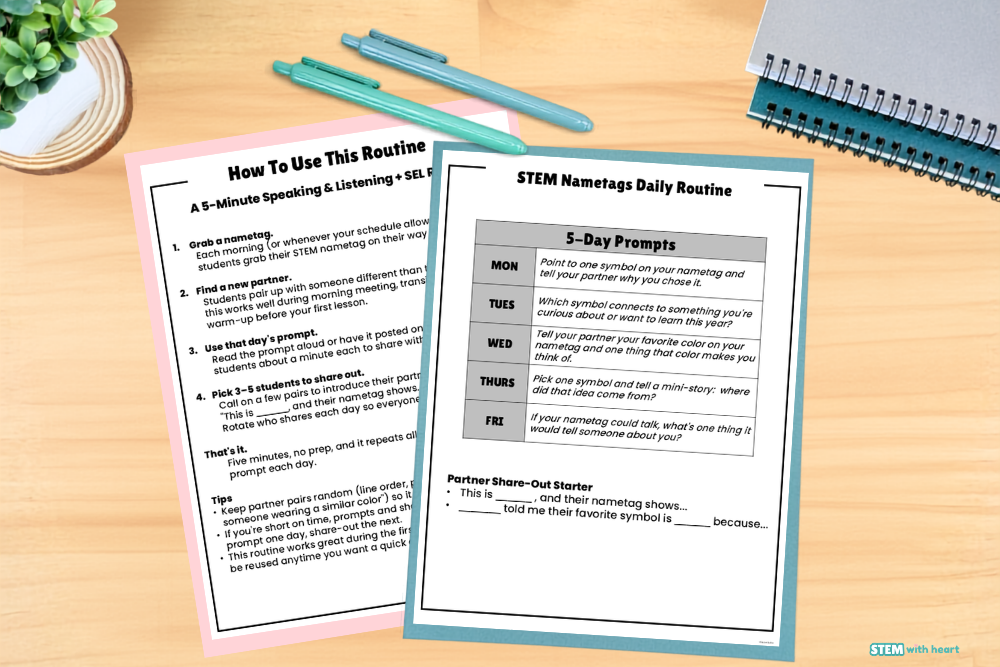
Here’s exactly how to run this first day of school STEM activity tomorrow:
- Grab a nametag. Each morning (or whenever your schedule allows), students grab their STEM nametag on the way to their spot.
- Find a new partner. A different partner than the day before, line order, popsicle sticks, or “find someone wearing a similar color” all work well.
- Use that day’s prompt. Read it aloud or post it on the board. Give students about a minute each to share.
- Pick 3–5 pairs to share out. Rotate who shares each day so everyone gets a turn over time, using a simple starter like “This is ___, and their nametag shows…”
That’s it. Five minutes, no prep, and it repeats all week with a new prompt each day.
A couple of sample prompts to give you the feel of it:
- Monday: “Point to one symbol on your nametag and tell your partner why you chose it.”
- Friday: “If your nametag could talk, what’s one thing it would tell someone about you?”
Notice the arc, Monday starts concrete and safe (a symbol, a reason), and by Friday kids are being asked something a little more reflective. That’s intentional pacing, not an accident which is exactly what makes this simple first day of school STEM activity worth repeating all week.
Tips that make it run smoother:
- Keep partner pairs genuinely random so it stays fresh, don’t let kids default to their usual friend.
- Short on time one day? Split it: prompt on one day, share-out the next.
- This isn’t just a beginning-of-year tool. Pull it back out anytime you want a quick community-building reset, after a break, after a rough week, whenever the room needs it.
Frequently Asked Questions
How long does this routine take each day?
About five minutes, roughly a minute for partners to share, plus a couple of minutes for 3–5 pairs to share out with the class.
Do I need to prep anything after the first day?
No. Once the nametags are made, the routine repeats with a new prompt each day. No new materials, no new setup.
What if I only have time for part of it some days?
Split it across two days, do the partner prompt one day, and save the whole-class share-out for the next. It still works.
Does this only work at the start of the school year?
Not at all. It’s built to be reusable anytime your class needs a quick reset, after a long break, a tough week, or whenever you want a fast community-building check-in.
How do I keep partner pairings random so it doesn’t get stale?
Line order, popsicle sticks, or a quick “find someone wearing a similar color” all work well and take seconds to set up.
Is this a good first day of school STEM activity for every grade level?
Yes, this first day of school STEM activity works welol for grades 3 through 5.
The Bottom Line
The room you walk into on day one isn’t the room you’ll have in October, you build that room, five minutes at a time, through the small routines you choose to repeat.
A nametag doesn’t have to be a task to get through before the real teaching starts.
Done as a routine instead of an event, it is the real teaching, and it starts paying off long before the first unit test.
Get Your FREE 5-Day Daily Prompt Routine
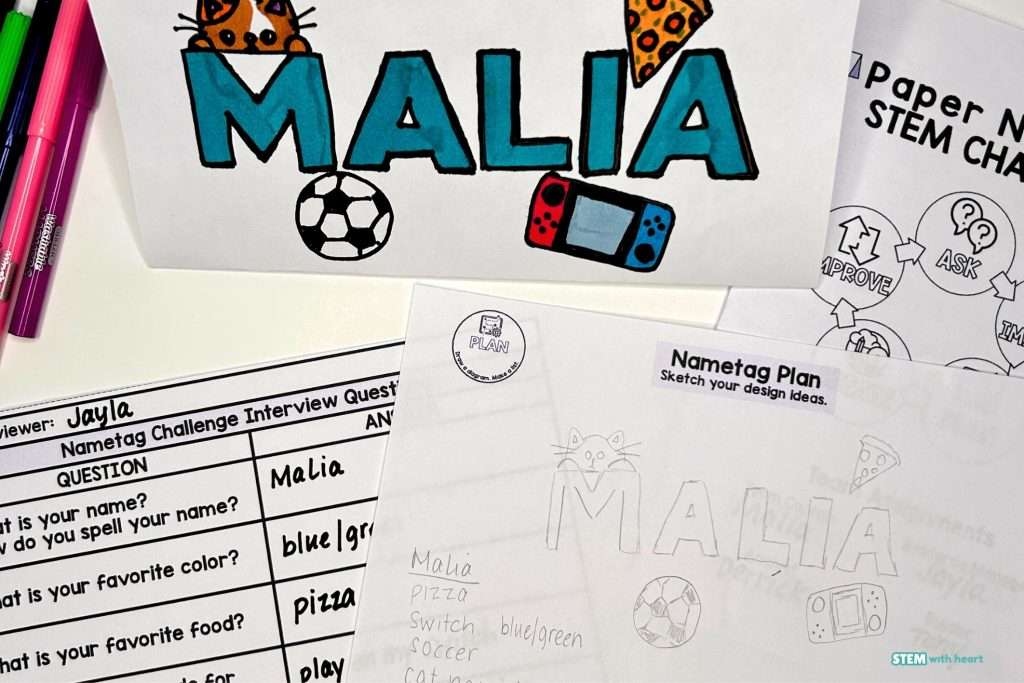
Want the STEM Nametag Challenge that inspired this routine? Check out the full STEM + SEL Nametag Challenge with a twist! This challenge requires students to interview AND listen to each other so that they can design and create a nametag for their partner.
With heart,