STEM classroom management can get tricky the moment a hands-on challenge stops going according to plan.
The tower collapses.
The tape disappears.
Someone insists, “You’re doing it wrong!”
And suddenly a STEM lesson that started with excitement turns into frustration, tears, or an argument between teammates.
If you teach STEM in an upper elementary classroom, you’ve probably seen it happen. Hands-on challenges ask students to collaborate, compromise, handle failure, change their ideas, and keep going when something doesn’t work. That’s a lot of social-emotional work happening alongside the engineering.
That’s why one of my favorite STEM classroom management strategies isn’t about preventing frustration altogether. It’s about giving students a predictable way to work through it.
I use a simple three-step framework:
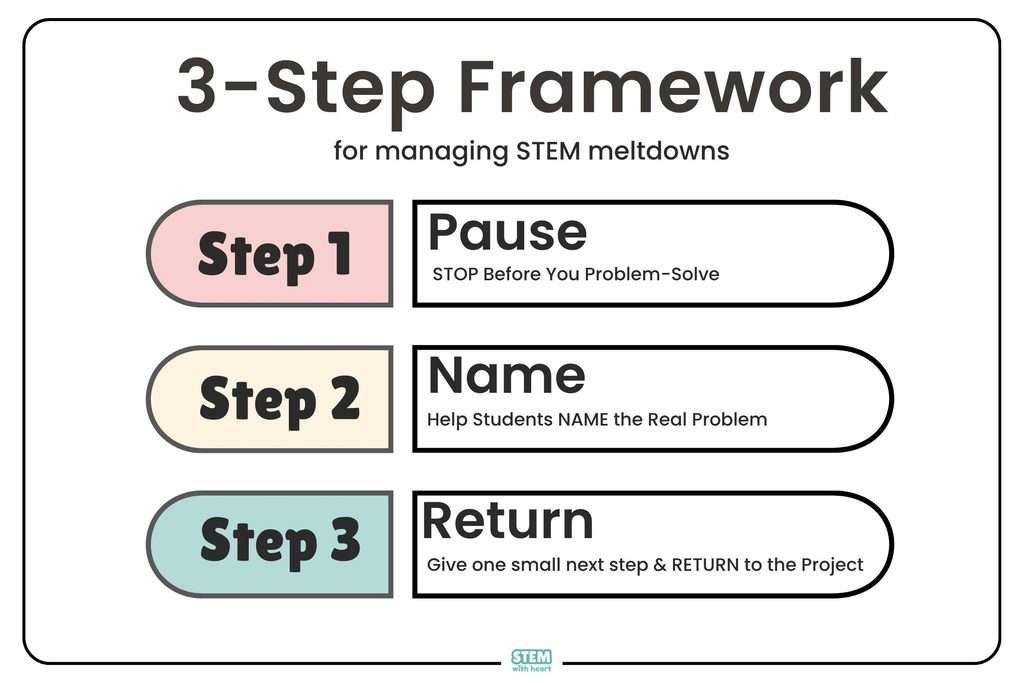
PAUSE → NAME → RETURN
Pause before problem-solving. Name the real problem. Then return to the project with a plan for what to try next.
Key Takeaways
- STEM meltdowns are usually SEL gaps, not engineering failures, kids haven’t yet learned how to work through frustration together.
- Fixing the emotion before fixing the project changes the entire trajectory of the lesson.
- Naming the real problem (“teamwork problem or engineering problem?”) moves students from blaming each other to solving something specific.
- Reframing failure as data, “what did we learn, what do we try next”, is what engineers and scientists actually do, and it’s teachable.
- A dedicated calm-down space gives students a tool to reset on their own, without pulling you away from the rest of the class.
Table of Contents
Why STEM Behavior Management Gets So Hard, So Fast
I’ve taught STEM long enough to know the pattern by heart: a group is cruising, a tower falls, and in about four seconds the whole table goes from collaborating to blaming. My instinct used to be to jump in and fix the conflict, reassign roles, hand over more tape, smooth it over so we could keep moving.
That instinct is understandable. It’s also backwards.
CASEL’s own SEL competencies, self-awareness, self-management, social awareness, relationship skills, and responsible decision-making, line up almost exactly with what a strong engineering design process asks of kids: manage frustration, communicate through disagreement, and make a responsible call about what to try next. Students aren’t missing the engineering skills when a meltdown hits. They’re missing the SEL skills that make the engineering possible.
Once I started treating those moments as teaching opportunities instead of interruptions, everything shifted. Here’s the framework I use.
The Pause-Name-Return Framework for STEM Classroom Management
Step 1: Pause Before You Problem-Solve
When emotions get big, thinking gets small. If students are overwhelmed, they’re not ready to hear a solution, a suggestion, or feedback, even good feedback.
Instead of jumping straight to fixing the conflict, create space to regulate first:
- “Let’s pause for one minute.”
- “Take three deep breaths before we decide what to do next.”
- “Everyone step back from the project for a moment.”
Even thirty seconds can completely change where the conversation goes. You’re not stopping the learning. You’re preparing students to learn again.
Step 2: Help Students Name the Real Problem
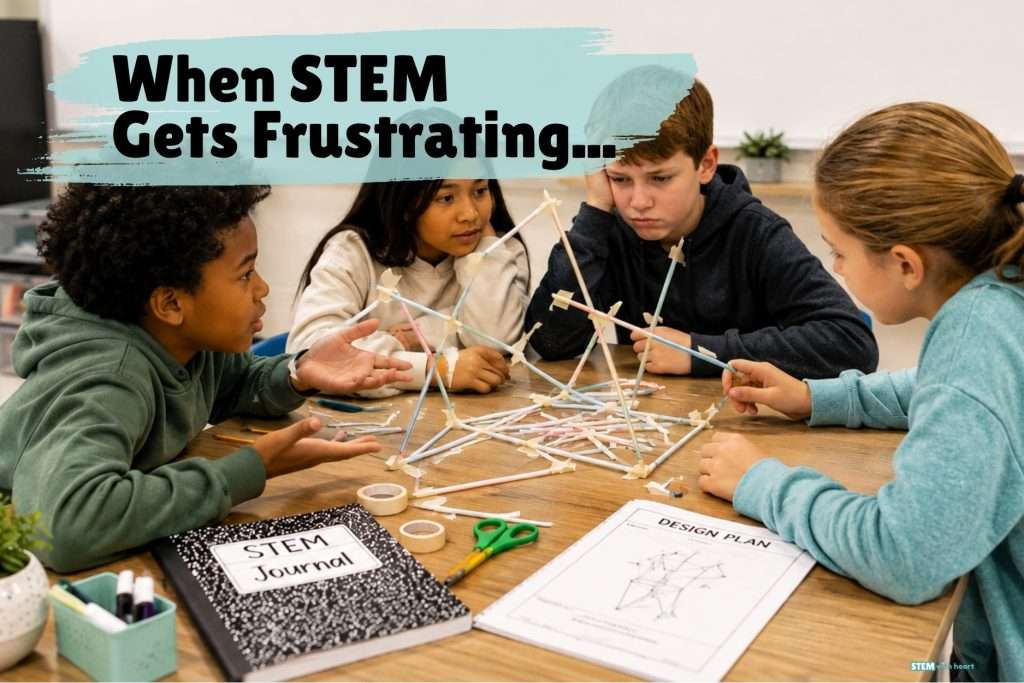
Once students are calmer, move past the surface complaint. Students will say things like “She ruined it,” “He won’t listen,” or “Everything is broken” , and none of those are the actual problem.
Ask questions that dig one layer deeper:
- What happened?
- What were you hoping would happen instead?
- What part feels frustrating?
- Is this a teamwork problem or an engineering problem?
This question does the real work. It teaches kids to separate the emotion from the challenge underneath it. Sometimes it’s a weak bridge. Sometimes it’s a disagreement about roles. Sometimes it’s disappointment after three failed attempts in a row. Each of those needs a different response, and students can’t solve the right problem until they’ve named it.
Step 3: Return to the Design Process
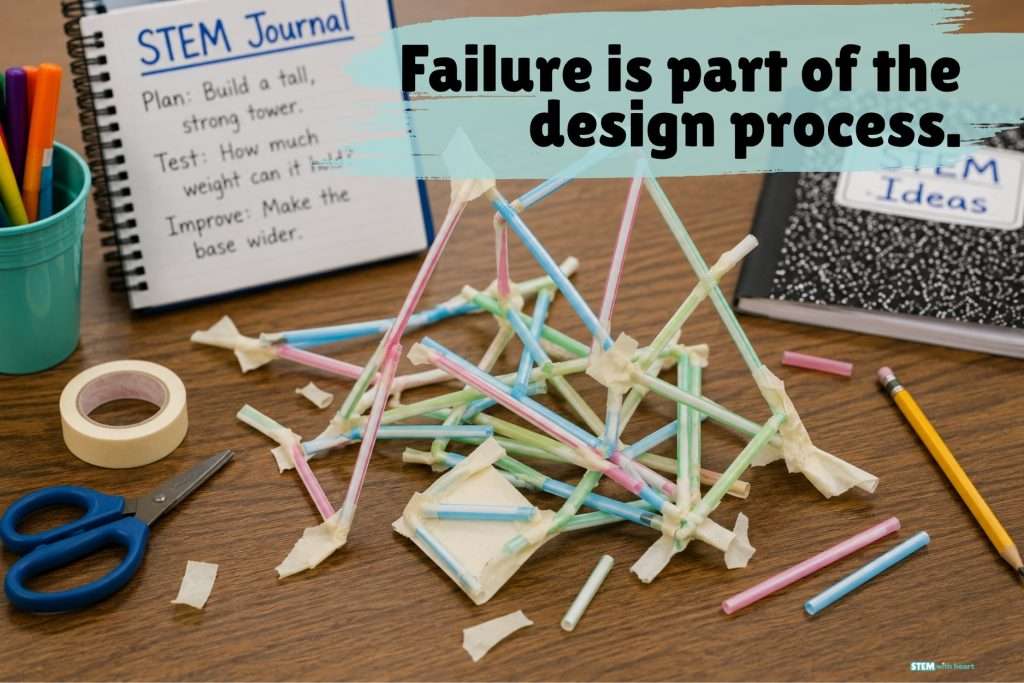
Failure is already built into a strong STEM lesson, that’s kind of the point. Engineers expect designs to fail. Scientists expect experiments to produce unexpected results. Inventors revise, over and over.
Remind students their project isn’t ruined. It’s giving them information.
Instead of “Who messed up?” try:
- What did we learn?
- What can we change?
- What’s our next test?
- Which idea should we try now?
That small language shift moves the room from blame to curiosity, and curiosity is where the actual learning happens.
Okay, This Isn’t Just a Teacher Hunch (The SEL and STEM Research)
I know, I know, every blog post says “research shows.” But stick with me for two sentences, because this one’s worth it.
CASEL (basically the go-to name in SEL research) rounded up 46 studies and found that the large majority showed SEL made a real, measurable difference in academic outcomes, not just “kids felt nicer,” actual test scores and performance (CASEL, 2024). And separately, ACT’s Mosaic team found double-digit gains in achievement scores for students getting SEL support, with “sticking with something when it’s frustrating” tracking almost directly with their STEM readiness benchmark (ACT/Mosaic).
Honestly? None of that surprises me if you’ve ever watched a table go from full meltdown to “wait, try THIS” in the same 45-minute block. Good engineering design already asks kids to collaborate, fail, and try again, that’s an SEL skill-builder built right in. It just needs a teacher who’s willing to treat the meltdown as part of the lesson instead of the thing standing in the way of it.
Build These Skills Before the Meltdowns Happen
It’s a lot easier to navigate conflict when kids already share a language for emotions and problem-solving. I intentionally teach:
- Recognizing frustration
- Calming strategies
- Respectful communication
- Teamwork expectations
- Growth mindset
- Flexible thinking
These aren’t separate from STEM.
They’re what makes successful STEM possible.
When students know how to regulate emotions, communicate respectfully, and persevere through setbacks, they’re able to tackle more complex engineering challenges with confidence.
One Classroom Routine That Makes STEM Classroom Management Easier
The single strategy that’s made the biggest difference in my room: giving students a designated space to reset when they need it.
Not as a consequence, as a tool they choose. A calm-down space stocked with reflection prompts, breathing strategies, and problem-solving tools helps kids regulate and get back to the table faster than you standing over them repeating “calm down” ever will.
The goal isn’t to avoid the hard feelings. It’s to teach kids what to do with them.
Frequently Asked Questions
Do STEM meltdowns mean my lesson or project is too hard?
Not necessarily. A challenging project is supposed to produce some frustration, that’s built into engineering design. A meltdown usually signals a missing SEL skill (regulation, communication, flexible thinking), not a project that needs to be simplified.
How long should the “pause” step actually take?
Often just 30 seconds to a minute. The goal is a brief reset, not a long break from the activity. A few deep breaths or a short step-back from the table is usually enough to bring thinking back online.
What if I don’t have room for a dedicated calm-down space?
A calm-down corner can be a small tray, a rolling cart, or even a designated seat with a laminated prompt card. The tools matter more than the square footage, reflection prompts and a breathing strategy card can travel anywhere.
Should I let a “ruined” project just get thrown away?
Rarely. Revisiting a failed design and asking what to change next is where most of the real engineering learning happens. Tossing it and starting fresh skips the reflection step that makes the failure useful.
How do I get quieter or younger students to open up during Step 2?
Offer sentence starters instead of open questions, “I felt frustrated when…” or “Next time I want to try…” Younger and more reserved students often need a scaffold before they can name what’s actually wrong.
Why STEM Classroom Management Is Really About More Than Behavior
STEM is supposed to be challenging. That’s the point.
Effective STEM classroom management doesn’t mean every group works quietly or every challenge goes smoothly. It means students have the tools to navigate frustration, disagreement, and failure without those moments ending the learning.
The goal was never to prevent every meltdown. It’s teaching kids how to move through frustration, solve problems together, and keep trying. Those are the skills they’ll carry long after they leave your classroom, and honestly, they might be the most valuable thing STEM has to offer.
Pause. Name. Return. It’s small enough to use in the middle of a lesson and durable enough to shape how your students handle hard things all year.
Ready to Help Students Navigate Big Feelings During STEM?
If your students need extra support working through frustration, conflict, or disappointment during hands-on activities, a dedicated calm-down space can make all the difference. My Calm Down Corner Kit gives upper elementary students practical tools to regulate emotions, reflect on problems, and return to learning with confidence.
It’s designed to work alongside STEM lessons, not interrupt them, so students build resilience while continuing to solve, create, and collaborate.
Keep Learning
- The 4 C’s of STEM, Explained (Without the Jargon): the framework behind every hands-on STEM lesson in this post.
- How to Make Classroom Jobs More Meaningful (While Building SEL Skills): another way to build the CASEL competencies into daily routines.
- How to Develop Emotional Intelligence in Students: a deeper look at the regulation and naming skills Step 1 and Step 2 depend on.
With heart,