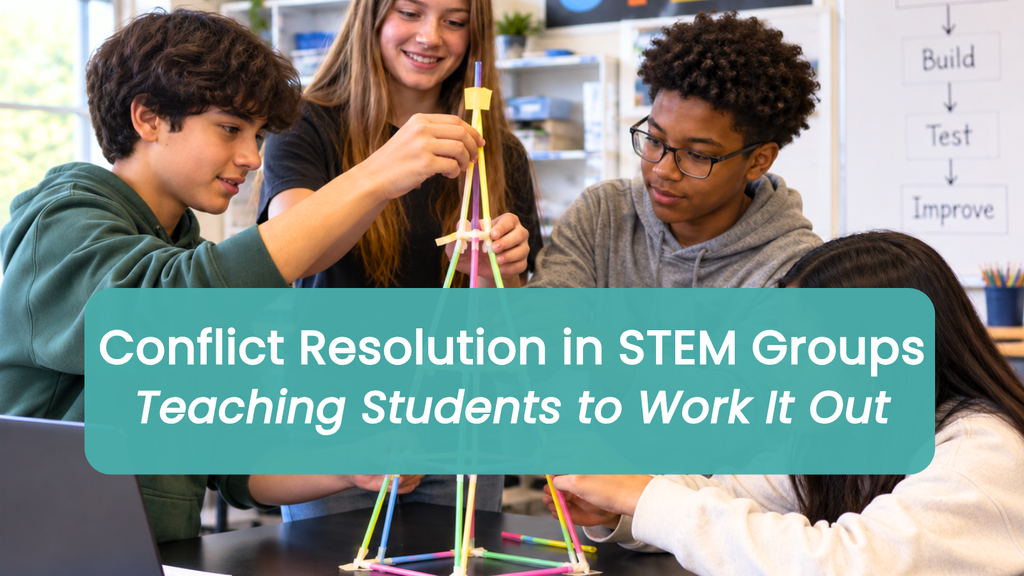
You’re ten minutes into a STEM challenge when you hear it.
“She won’t listen to my idea!”
“But he keeps taking over!”
“We’re doing it MY way!”
And suddenly, you’re not facilitating an engineering challenge. You’re refereeing one.
Conflict resolution in STEM is one of those skills we don’t always think about teaching ahead of time—but once students start working in teams, it quickly becomes essential.
If you use STEM challenges in your classroom, you already know that some of the best learning happens when students work together. You probably also know that putting four students around a pile of materials does not automatically create a collaborative team.
Disagreement is going to happen.
Students will have different ideas. Someone will want to take over. Someone else will feel ignored. Two students will be absolutely convinced that their design is the only one that will work.
The solution isn’t to eliminate conflict from STEM activities.
It’s to teach students what to do when conflict happens.
That’s where conflict resolution becomes an important part of STEM learning, and a perfect opportunity to intentionally build SEL skills at the same time.
Why Conflict Resolution in STEM Matters
Conflict resolution in STEM matters because STEM challenges create almost perfect conditions for disagreement.
Students are working toward the same goal, but they may have completely different ideas about how to get there. They’re sharing limited materials. They’re making decisions under a time constraint. And, of course, they’re emotionally invested in their own ideas.
That isn’t necessarily a bad thing.
Engineers disagree. Designers revise ideas. Teams have to compare possible solutions and decide what to try next.
The problem comes when students don’t have the skills or language to move through the disagreement.
That’s when you start hearing:
- “That’s a dumb idea.”
- “You never let me do anything.”
- “I’m not working with them.”
- “Tell him he has to let me build.”
And the teacher becomes the default problem-solver.
Instead of solving every disagreement for students, we can give them a few simple strategies to try first.
If teamwork is a struggle before conflict even starts, these STEM teamwork activities and strategies can help you build stronger collaboration from the beginning.
Conflict Is a Normal Part of Teamwork
Before your next STEM challenge, ask your students:
Have you ever disagreed with a teammate during a group activity?
Chances are, every hand will go up.
This is actually an important conversation to have before students ever pick up the building materials.
Conflict is a normal part of working with other people. How we handle that conflict is what makes the difference. That message is already at the heart of the conflict-resolution mini-lesson I use with my students..
The goal isn’t:
Good teams never disagree.
Instead, teach students:
Good teams know how to work through disagreements.
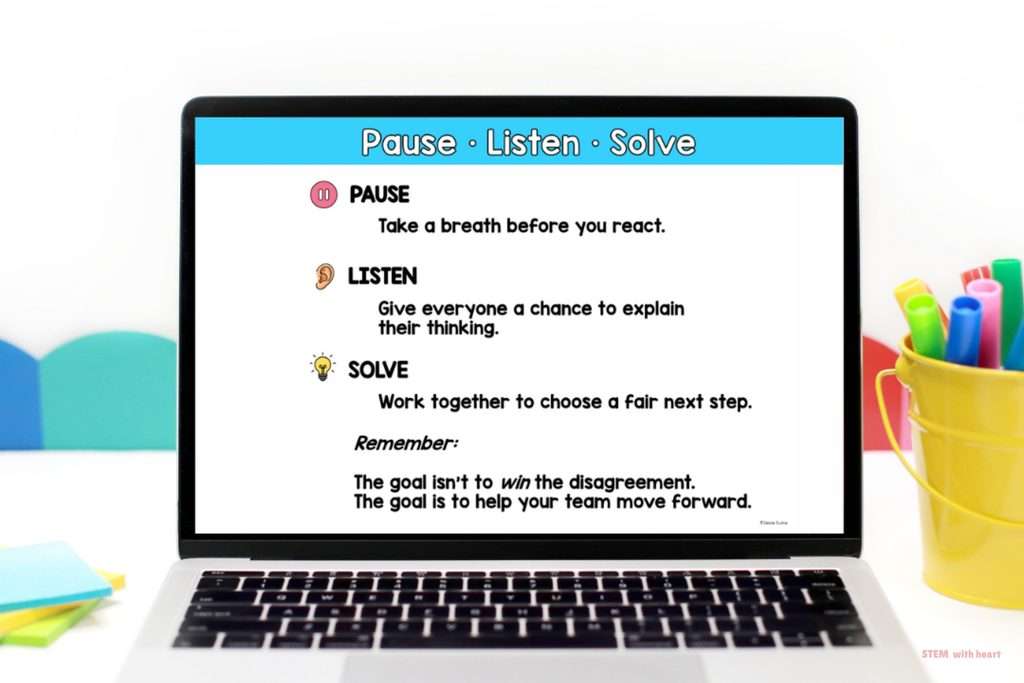
One simple routine can give them a place to start:
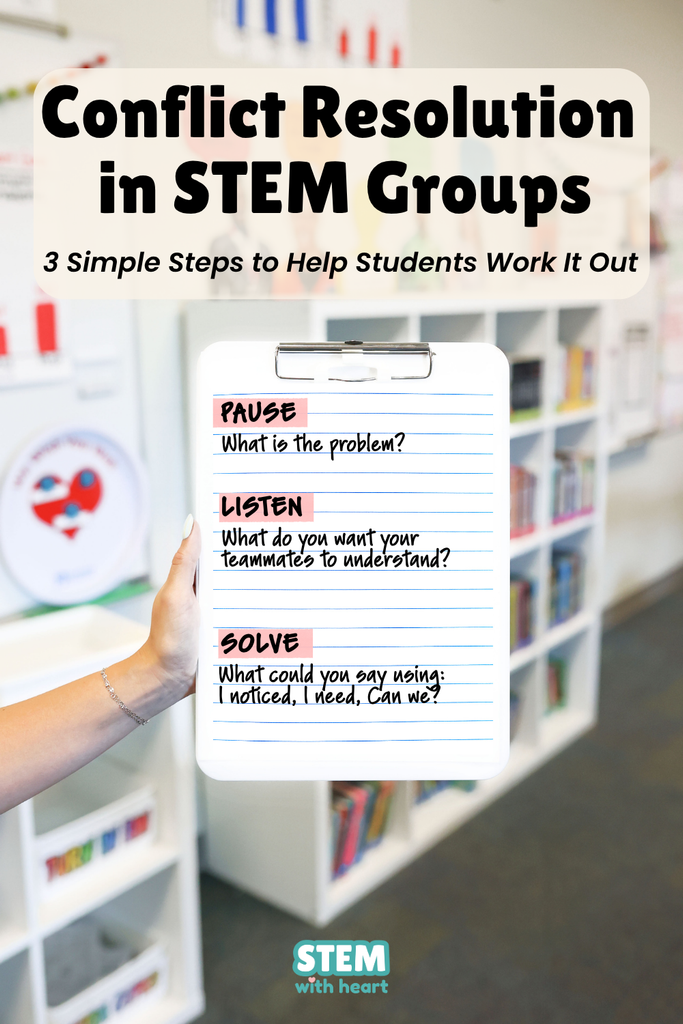
PAUSE → LISTEN → SOLVE
Rather than telling students to “just work it out,” we’re giving them an actual process for doing it.
Step 1: PAUSE Before Reacting
When students disagree, their first instinct may be to argue harder.
Or grab the materials.
Or walk away.
Or immediately call:
“TEACHER!”
Teach students that the first step is simply to pause.
Stop what you’re doing. Put the materials down if necessary. Take a breath.
Then ask:
What is the actual problem?
Maybe two people want to build.
Maybe one person feels like their ideas are being ignored.
Maybe the group has two completely different designs and can’t decide which one to try.
The pause isn’t meant to make the disagreement magically disappear. It simply keeps the conflict from getting bigger long enough for students to figure out what’s actually going on.
Step 2: LISTEN to Each Other
Once students have paused, everyone involved needs an opportunity to explain their perspective.
And that means actually listening—not just waiting for your turn to prove why your idea is better.
Teach students to:
- Listen without interrupting.
- Let each person explain what they think is happening.
- Try to understand the other person’s point of view.
- Focus on the problem rather than blaming the person.
Active listening is already part of my current conflict-resolution mini-lesson: students are taught to listen to what another person is saying without interrupting before trying to reach a compromise.
One question I love for this step is:
“Can you explain your teammate’s idea before you explain yours?”
If they can’t, they probably aren’t ready to solve the problem yet.
And this is one of the reasons STEM challenges are such a natural place to teach SEL.
Students aren’t practicing listening because it’s written on a worksheet.
They need to listen because their team has a real problem to solve together.
Step 3: SOLVE the Problem Together
Once everyone understands the problem, it’s time to figure out what happens next.
This is often the hardest part for students.
They know they’re frustrated. They may even be able to tell you why they’re frustrated.
But they don’t necessarily have the language to turn that frustration into a productive conversation.
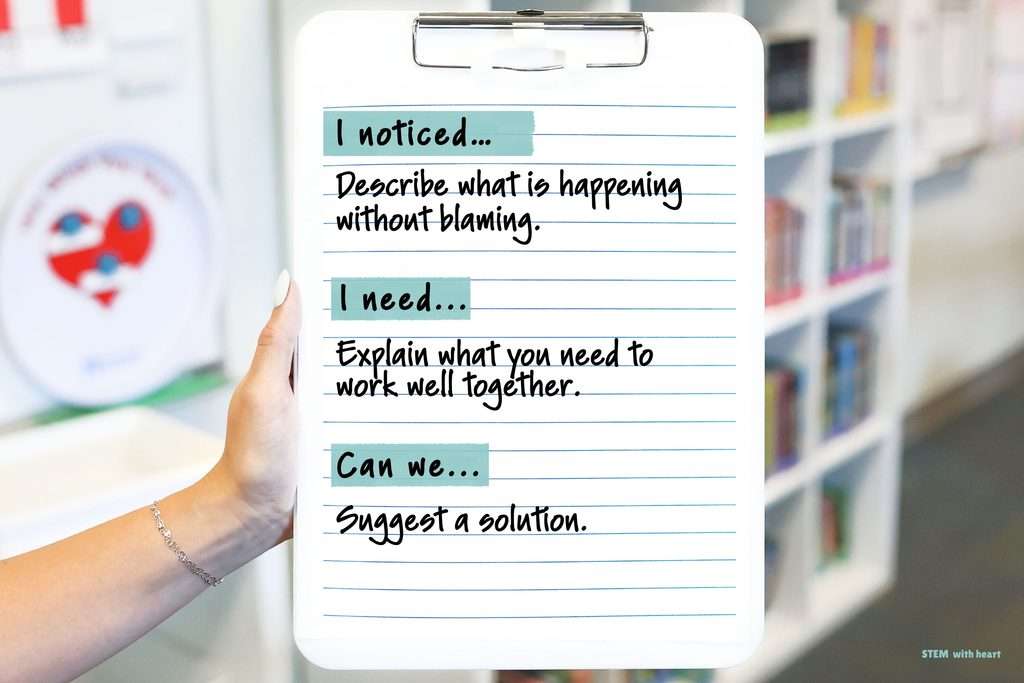
That’s why I like giving students a simple conflict-resolution script:
“I noticed…”
Describe what is happening without blaming.
“I need…”
Explain what you need to work well together.
“Can we…”
Suggest a solution.
For example:
“I noticed I’ve shared two ideas, but we haven’t talked about either one. I need a chance to contribute too. Can we listen to everyone’s idea before we choose?”
Or:
“I noticed you’ve been doing most of the building. I need a chance to help too. Can we take turns building?”
Compare that with:
“He’s being bossy!”
or
“She won’t let me do anything!”
The conflict-resolution script shifts students away from blaming the other person and toward identifying the problem, communicating what they need, and proposing a solution.
That’s a skill that goes far beyond one STEM challenge.
What If Students Are Still Stuck?
Sometimes students will pause.
They’ll listen.
They’ll talk through the problem.
And they’ll discover that they simply have two perfectly reasonable ideas.
This is where I make an important distinction with students:
They may not have a conflict to resolve anymore.
They may simply have a decision to make.
And that’s when a few quick decision-making strategies can keep a two-minute disagreement from turning into a ten-minute STEM meltdown.
Test Both Ideas
Whenever possible, this is my favorite STEM solution.
Can the team build or test both ideas?
The evidence may make the decision for them.
And if the first idea doesn’t work? Great! That gives students information they can use during the Improve stage of the Engineering Design Process.
Combine the Ideas
Ask:
Is there something from both ideas we could use?
One student might have an idea for the base while another has an idea for the launching mechanism.
The solution doesn’t always have to be Idea A or Idea B.
Take a Vote
If everyone has had an opportunity to share their thinking, let the team vote and move forward with the majority decision.
Use a Quick Chance Strategy
When both options are reasonable and the team simply needs to choose which one to try first, use something quick:
- Rock, Paper, Scissors
- Flip a coin
- Roll a die
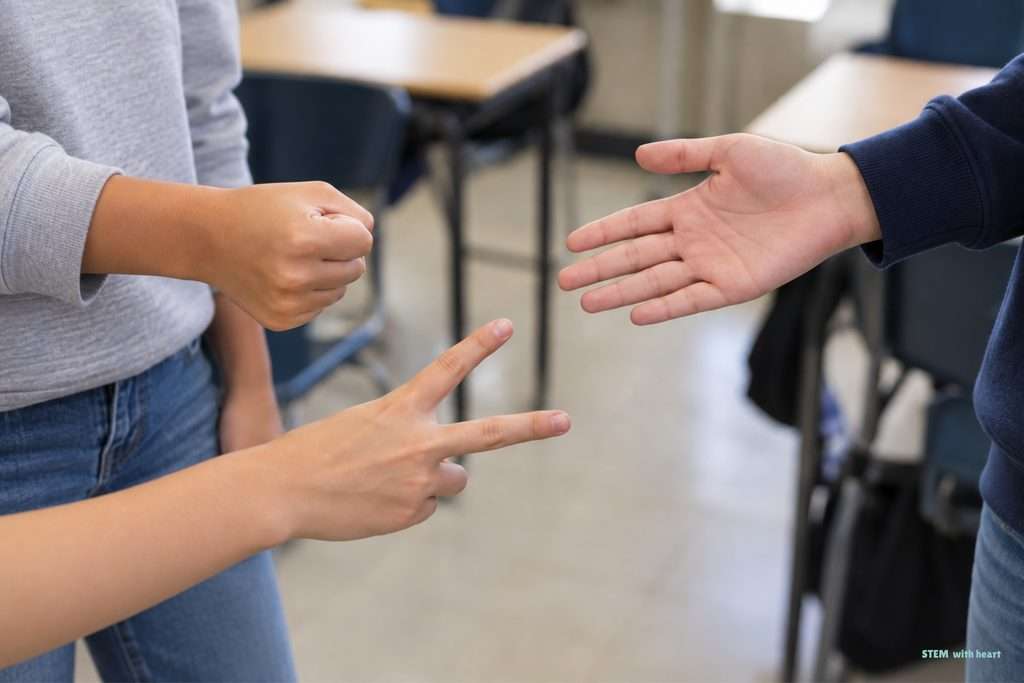
These strategies are included in my current conflict-resolution lesson. With the updated approach, I’d think of them a little differently: they’re decision-making tools rather than the conflict-resolution process itself.
A coin flip can decide which catapult design gets tested first.
It can’t solve:
“I don’t feel like anyone on my team is listening to me.”
That’s what Pause → Listen → Solve is for.
Practice Conflict Resolution Before Students Need It
Here’s the part that’s easy to skip:
Don’t introduce this routine for the first time when two students are already frustrated with each other.
Practice it when nobody is upset.
One of the best ways to teach conflict resolution in STEM is to practice the routine before students actually need it.
Before a STEM challenge, give students a simple scenario:
Two teammates both want to build. One student has been holding the materials and hasn’t given the other student a turn.
Then walk through the routine together.
PAUSE: What is the problem?
LISTEN: What might each teammate want the other person to understand?
SOLVE: What could someone say using I noticed, I need, Can we?
Students might come up with:
“I noticed you’ve been doing most of the building. I need a chance to contribute too. Can we take turns?”
You can also practice with design disagreements:
Two students have different ideas for how to build the base of their structure. Both think their design will work best.
Could they combine their ideas?
Test both?
Take a vote?
Use Rock, Paper, Scissors to choose which one to test first?
A few minutes of practice before the challenge can save you a lot of refereeing once the materials come out.
Stop Solving Every STEM Conflict for Students
Teaching conflict resolution doesn’t mean you’ll never need to intervene in a STEM group again.
Of course you will.
But not every disagreement requires you to immediately provide the solution.
When a student approaches you with:
“She won’t listen to me!”
Instead of immediately stepping in, try asking:
“Have you used Pause, Listen, Solve?”
Or:
“What could you say using I noticed, I need, Can we?”
If students have already worked through the process and still need help, then you can step in and coach them.
But over time, something pretty great starts to happen.
Instead of:
“TEACHER!”
You start overhearing:
“Wait. Let’s pause.”
“Okay, tell me your idea.”
“I noticed I haven’t had a turn yet…”
“Can we try yours first and mine next?”
“Why don’t we test both?”
That’s the goal.
Not a perfectly quiet STEM classroom.
Not teams that never disagree.
But students who are gradually learning how to handle disagreement without needing an adult to solve every problem for them.
And when a disagreement starts turning into frustration, my 3-step framework for managing STEM meltdowns can help students reset without derailing the entire challenge.
Make Conflict Resolution Part of Your STEM Routine
Conflict resolution in STEM works best when it isn’t something we teach only after there’s a problem.
Make it part of your STEM expectations from the beginning.
Before students start a challenge, remind them:
PAUSE. Stop before reacting.
LISTEN. Make sure everyone has been heard.
SOLVE. Use I noticed, I need, Can we to find a way forward.
And if the team has talked it through but simply can’t decide which idea to try?
Test it. Combine it. Vote on it. Or use a quick decision-making strategy and keep going.
Now “work it out” actually means something.
Students have a process.
They have language.
And they have strategies they can use without waiting for you to referee every disagreement.
Because STEM isn’t only about building a successful tower, bridge, catapult, or prototype.
Students are also learning how to communicate, compromise, advocate for themselves, listen to other perspectives, and solve problems together.
And those may be some of the most important things we teach during a STEM challenge.
Put Conflict Resolution Into Practice With a STEM Challenge
Ready to give students a chance to practice these skills while they build?
My STEM + SEL Leap Frog Catapult Challenge combines the Engineering Design Process with an intentional focus on conflict resolution. Students learn a simple process for working through disagreements, practice the language they can use with teammates, and then put those skills to work as they design, build, test, and improve their catapults.
➡️ See the Leap Frog Catapult STEM + SEL Challenge
And if you’d like to put some teamwork structures in place before the conflict starts, grab my FREE STEM Team Roles. Giving each student a meaningful responsibility is one simple way to make collaboration more manageable from the beginning.
➡️ Grab the FREE STEM Team Roles
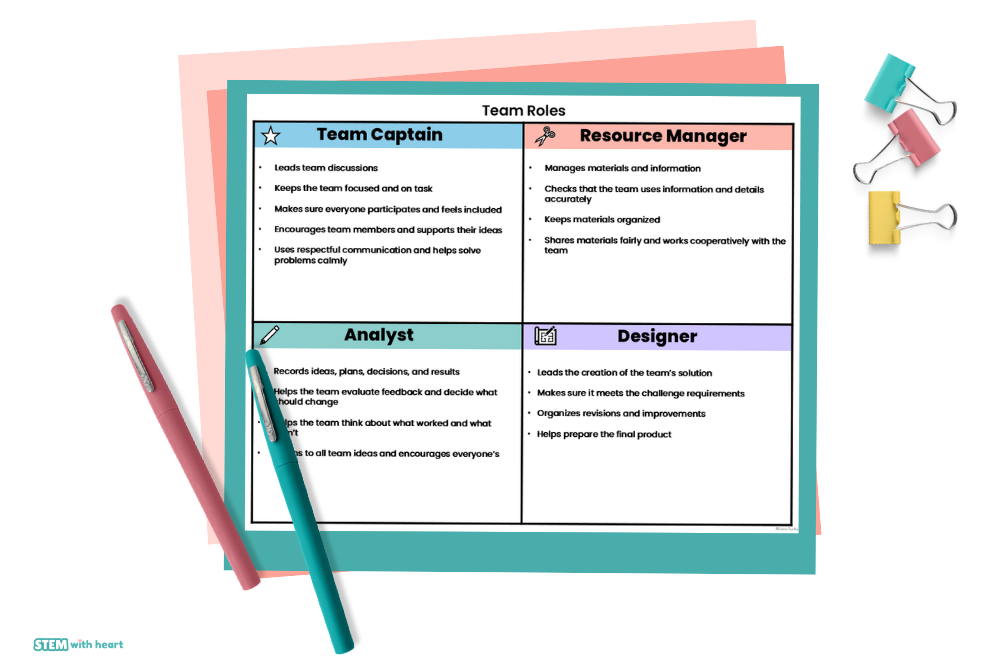
Conflict resolution is just one of the ways STEM gives students an authentic opportunity to practice social-emotional skills. Here are more ideas for adding SEL to STEM activities you’re already teaching.
With heart,